
The Musée des Confluences by CoopHimmelb(l)au in Lyon
Conseil Géneral du Rhône
COOP HIMMELB(L)AU Wolf D. Prix & Partner ZT GmbH
Spengergasse 37, A – 1050 Vienna

The Musée des Confluences by CoopHimmelb(l)au in Lyon
The Musée des Confluences (Museum of Confluences) is a science museum in Lyon, France, housed in a large deconstructivist-style building designed by Austrian architectural firm Coop Himmelb(l)au.
Above: the Musée des Confluences in Lyon, view from the Rhône River’s left bank; photo © Riccardo Bianchini / Inexhibit
The museum, inaugurated in December 2014, contains the large collection of the Musée Guimet – a Natural Science museum founded in the second half of the 19th century.
Located on the south end of the Presqu’île, the peninsula that forms the central part of Lyon, the Musée des Confluences’s name refers both to the geographical position of the museum site, at the confluence of the rivers Rhône and Saône, and to its mission, namely to bring together various fields of human knowledge in a single place.
Architecture
The Musée des Confluences was designed by the Austrian architectural practice Coop Himmelb(l)au as the winner of an international design competition organized in 2001.
On a gross floor area of 21,000 square meters – 2,800 of which are dedicated to the museum’s permanent exhibition and 1,900 to temporary exhibitions – the museum also accommodates two lobbies, a media library, two auditoriums, and several workshops.
The building, which presents an almost zoomorphic appearance coherent with the deconstructivist style for which Coop Himmelb(l)au is renowned, consists of three parts: The Plinth is a reinforced-concrete basement with two levels housing workshops, auditoriums, and the group lobby. This massive basement supports the above-ground part of the museum, which is divided into two parts entitled The Cloud and The Crystal.

View of the museum from the Pont Pasteur bridge; photo © Riccardo Bianchini / Inexhibit
The Crystal, a steel and glass construction oriented toward the city, houses the main entrance hall of the museum and gives access to the exhibition galleries located in the cloud.
A large 4-level volume supported by pillars with a 10,000-square-meter floor area, The Cloud is the core of the museum. It is conceived as a sequence of black boxes that provide great flexibility for permanent and temporary exhibitions and also houses the Muséolab digital workshop, administration offices, and a restaurant provided with a panoramic terrace. The museum also includes a garden, designed by CoopHimmeb(l)au as a socializing space located exactly at the confluence of the two rivers.


Close-up views of the glass-and-metal skin of the museum; photos © Riccardo Bianchini / Inexhibit

The pool of the Musée des Confluences; photo © Riccardo Bianchini / Inexhibit

The museum’s building is clad with a skin made of hundreds of stainless steel panels; photo © Riccardo Bianchini / Inexhibit
Exhibitions
The museum’s offer is based on its huge collections, amounting to over two million pieces collected by scientists and amateurs between the 16th and the 21st centuries.
An extraordinary and diverse set of objects, described by the curators as a “cabinet of wonders”, with finds related to a variety of disciplines: Mineralogy, Zoology, Paleontology, Entomology, and Ethnography. Inspired by such a rich collection, the Musée de Confluences features a permanent exhibition arranged in four main sections.
1- Origins: stories of the world presents the birth of our universe from both scientific and symbolic points of view.
2- Species: the living world describes the relationships between man, as an animal species, and the complex living environment around him.
3 -Societies: the human theater depicts the past and present social structures, cultural exchange between human cultures, and the quest of man for knowledge.
4- Eternities: Vision of the hereafter is focused on how death is approached by different cultures.

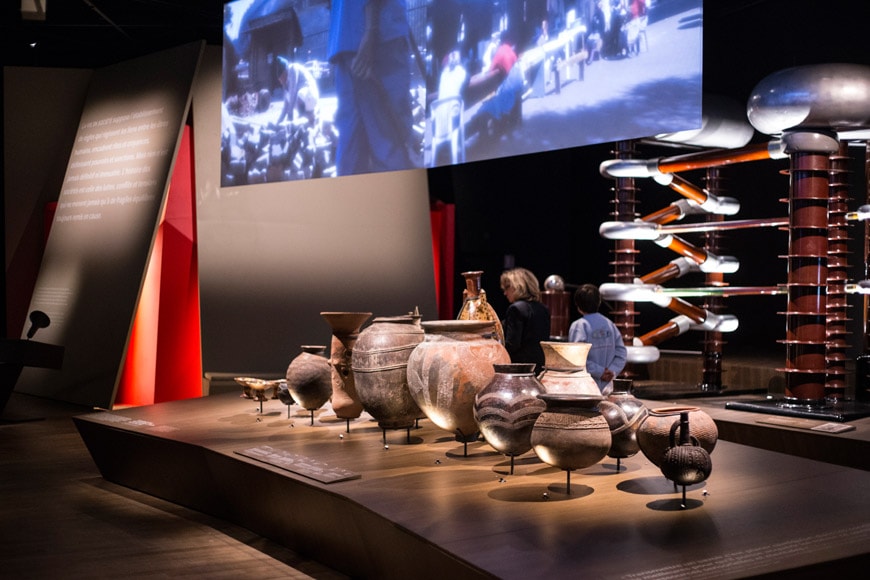
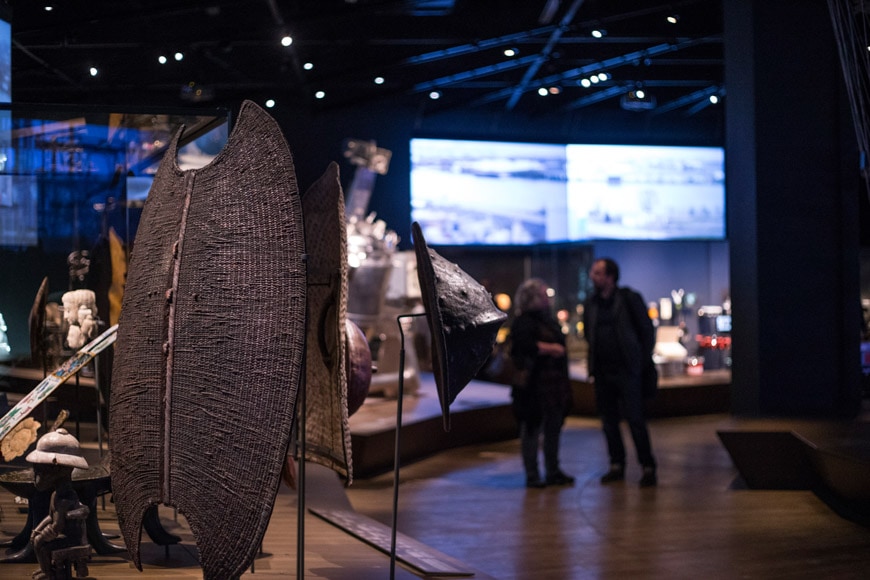

Interior views of the museum; photos Quentin Lafont – décembre 2014 – musée des Confluences, Lyon, France.
copyright Inexhibit 2026 - ISSN: 2283-5474