
Le Corbusier, Unité d’Habitation – Cité Radieuse, Marseille
Provence-Alpes-Côte d'Azur, France
How our readers rate this museum (you can vote)


 (6 votes, average: 3.67 out of 5)
 Loading...
One of Le Corbusier’s most celebrated architectural projects and a UNESCO World Heritage site, the Unité d’Habitation in Marseille—also known as Cité Radieuse—is a landmark residential building completed in 1952. Though permanently inhabited, parts of the complex remain open to the public.
Above, the Unité d’Habitation in Marseille by Le Corbusier, eastern facade; photo Wojtek Gurak (CC BY-NC 2.0) via Flickr.
History
Designed in the 1940s by Le Corbusier in collaboration with Portuguese architect and artist Nadir Afonso, the Marseille Unité was the first of five similar buildings constructed in France and Germany between 1952 and 1965.
Commissioned by the French government, represented by Minister of Reconstruction Raoul Dautry, the project aimed to serve as a prototype for a new generation of public housing in postwar France. To meet strict technical and financial constraints, Le Corbusier conceived a single monumental structure capable of housing up to 1,600 residents.
During the same period, he also proposed two larger complexes for La Rochelle and Saint-Dié, each designed to accommodate 20,000 people in eight Unité-style blocks. These schemes were never realized, but four additional Unités were eventually built in Nantes, Briey, Firminy, and Berlin between 1955 and 1965.
Although rooted in Le Corbusier’s earlier experiments of the 1920s and 1930s—such as the Immeubles Villas—the Marseille Unité marked a decisive stylistic shift. Its massive, organic presence and extensive use of raw concrete (béton brut) anticipated the Brutalist movement and foreshadowed Le Corbusier’s later works, including the convent of Sainte-Marie de La Tourette, the chapel of Notre-Dame du Haut, and his monumental projects in Chandigarh, India.
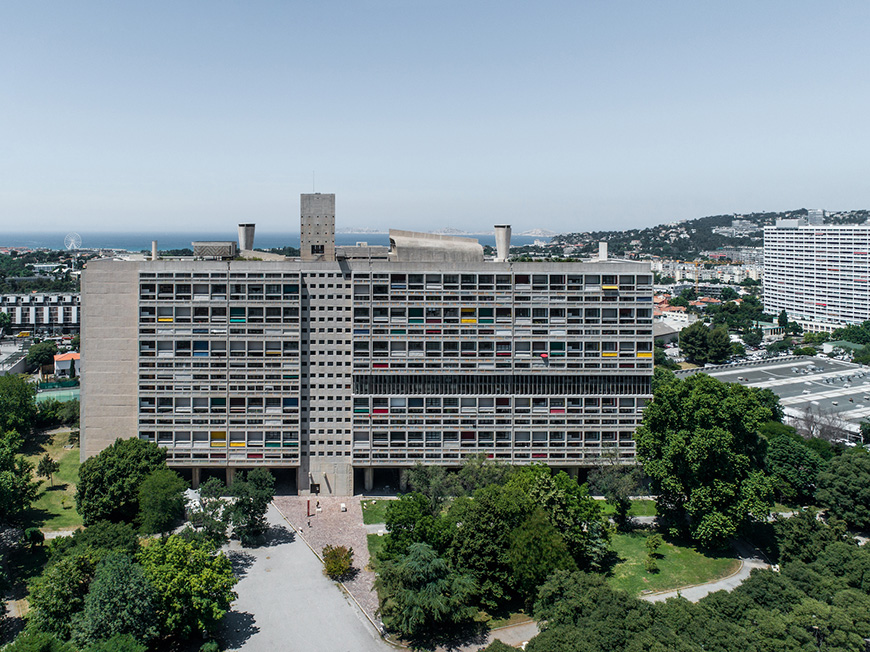
Aerial view from east, photo Denis Esakov (CC BY-NC-SA 2.0) via Flickr.
Architecture
Le Corbusier envisioned the building as a “vertical garden city”: an 18-story block containing 337 apartments of eight different types (A–H), offered in 23 variations.
Each apartment was based on a 15.5 m² (167 ft²) modular unit, with sizes ranging from a single module to 203 m² (2,185 ft²). Units could accommodate between one and ten people. The most common type, the E apartment, is a two-level dwelling for four residents, measuring 98 m² (1,055 ft²).
True to his concept of the machine à habiter (“machine for living”), Le Corbusier equipped the apartments with modern facilities intended to ease domestic work (“libérer la femme des contraintes domestiques”), their dimensions calibrated to his Modulor anthropometric scale.
A 120-meter-long corridor runs along each floor, serving both as access to the apartments and as a communal space for social interaction. Beyond housing, the building was conceived as a self-contained community, complete with gardens, shops, a restaurant, a library, medical services, a kindergarten, and a roof terrace featuring playgrounds, a swimming pool, and an open-air theater.
The stacking of duplex apartments is particularly ingenious: one level spans the full depth of the building, while the other occupies half, leaving space for the corridor.
Units alternate in layout – on one side, residents enter at living-room level and ascend to bedrooms; on the other, entry is at dining-room level, with stairs descending to living and sleeping areas.
This arrangement allowed for varied apartment types while maintaining a consistent structural module and minimizing the number of corridors.
The trade-off was relatively compact interiors by today’s standards, with some awkward distributions. Nevertheless, the design represents a sophisticated variation on the appartement traversant, a typology common in France and Switzerland.
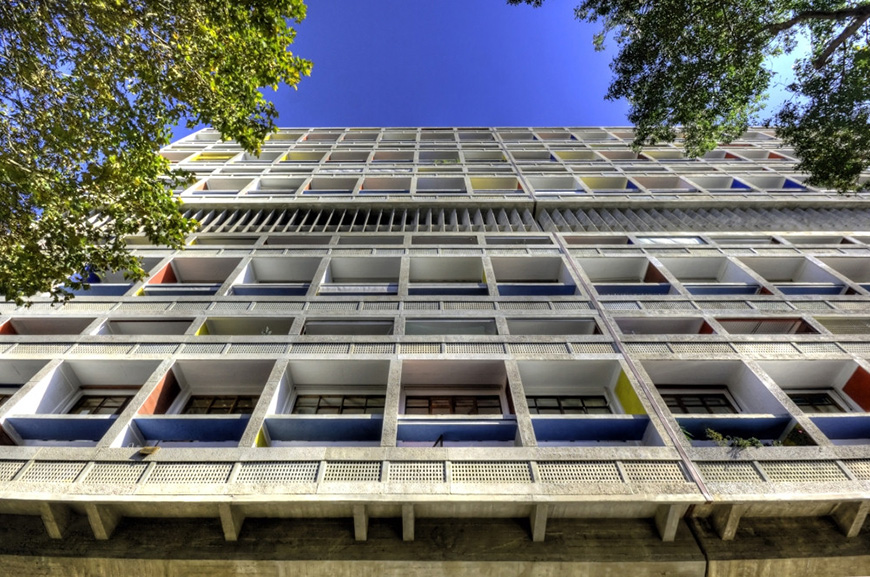
Close-up view of the east facade; photo Wojtek Gurak (CC BY-NC 2.0) via Flickr.
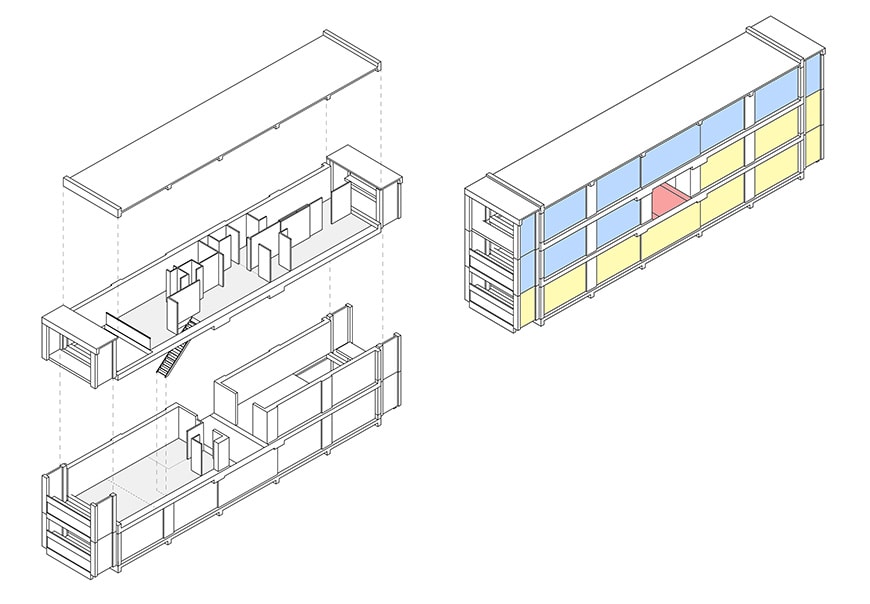
Axonometric drawing of an “E-type” two-level apartment; image by Alberto Contreras González (CC BY-SA 4.0) via Wikimedia Commons. The Unité d’Habitation in Marseille contains 8 types of apartments in 23 variants, all based on a 15.5-sqm module, that can accommodate from 1 to 10 people.

Plans and cross-sections of typical two-level apartments. 1 – main corridor, 2 – entrance, 3 – kitchen, 4 – living room and lunchroom, 5 – lunchroom, 6 – double bedroom, 7 – single bedroom, 8 – balcony, 9 – void, 10 – double bedroom, 11 – living room, 12 – built-in wardrobe, 13 – bathroom, 14 – shower. Image by Inexhibit.
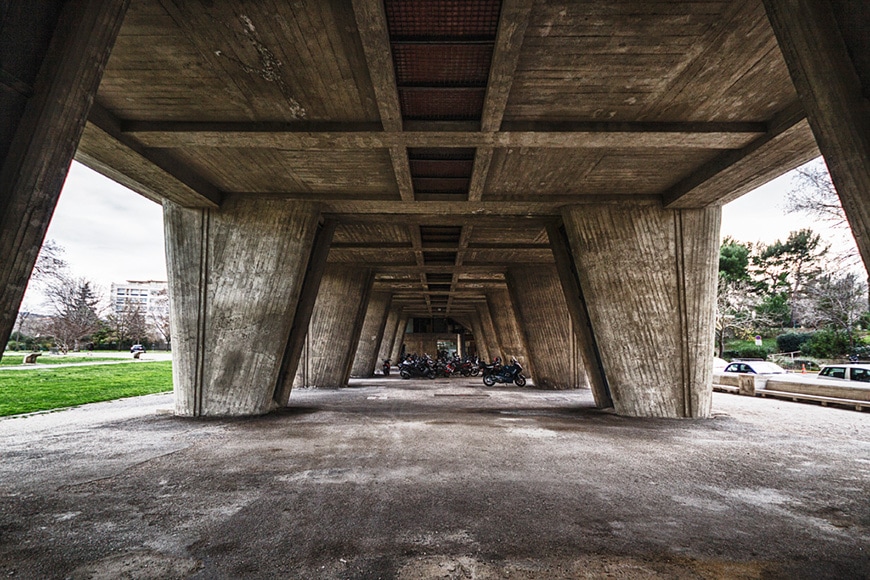
The building was raised on massive concrete pillars to leave the ground floor as free and open as possible; photo by Artur Salisz (CC BY-NC 2.0) via Flickr.
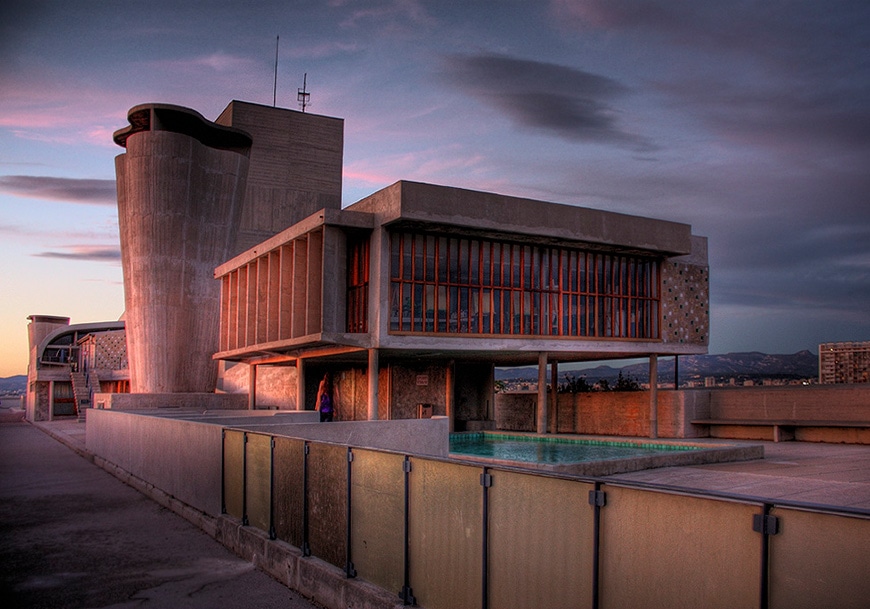
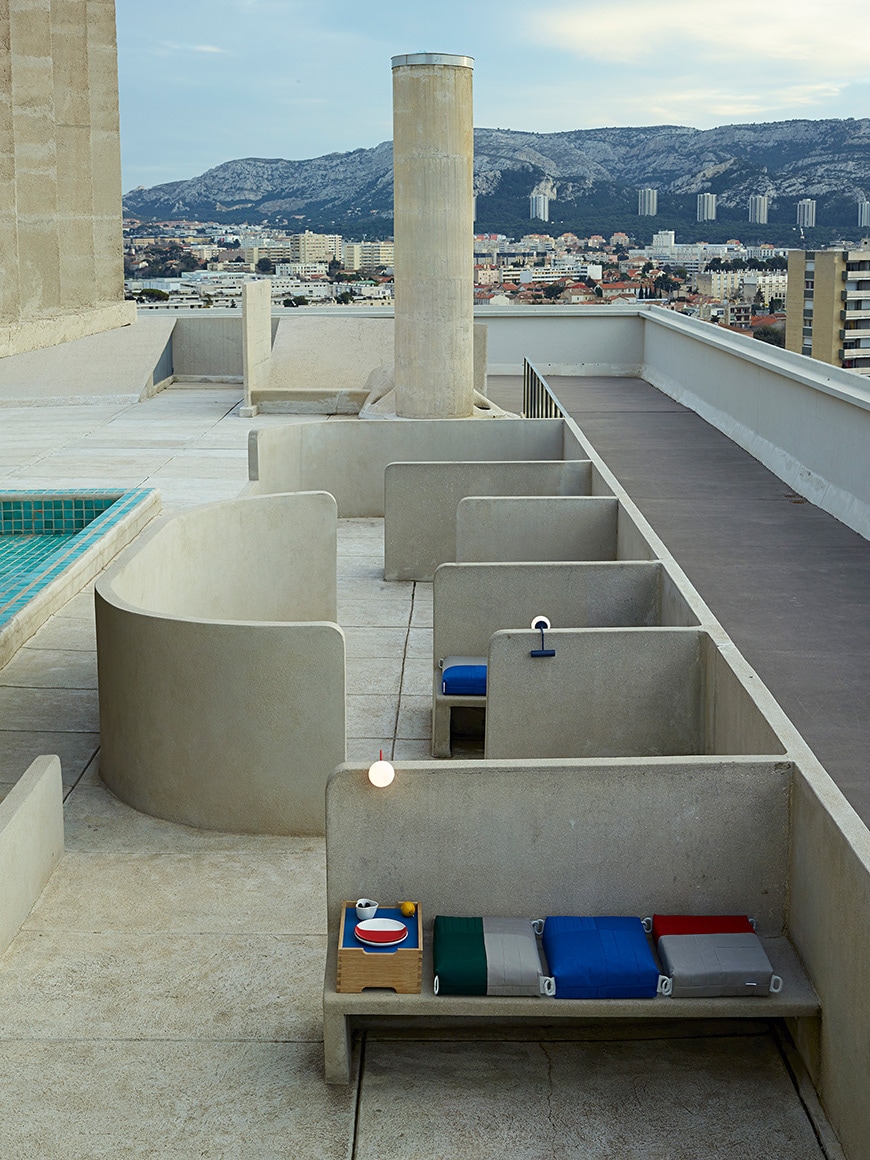
Two views of the roof terrace, photos by Guzmán Lozano (CC BY 2.0) via Flickr, and Michel Bonvin courtesy of The École Cantonale d’art de Lausanne (https://ecal.ch/fr/feed/events/1346/ecal-appartement-50-cite-radieuse/)
Reception
Upon completion, the Unité d’Habitation provoked mixed reactions. Admirers praised its visionary design and architectural innovation, while critics derided its scale and stark appearance. Locals nicknamed it La Maison du Fada (“The Madman’s House”), suggesting that living there would drive residents insane.
Later, detractors cast it as the prototype for anonymous, ghetto-like housing estates of the mid-20th century. Yet this judgment is largely unfair. In practice, the Marseille Unité fostered a vibrant community. Residents quickly organized an association in 1953, which remains active today.
More than seventy years later, the building is still popular among Marseillais. Apartments, despite their modest origins, command average prices above €4,000 per square meter ($4,600), reflecting both the building’s architectural prestige and its enduring appeal.
Visiting the Unité d’Habitation
Located in the Sainte-Anne neighborhood of Marseille’s 8th arrondissement, the Unité is accessible via metro lines M1 and M2 (Castellane stop) or bus line B1 (Le Corbusier stop).
Although inhabited, several areas are open to visitors. Tours, managed by the Association des Habitants de l’UH Le Corbusier Marseille, include the lobby, corridors on the 3rd and 4th floors with shops, the library, the winter garden, and the roof terrace. Two apartments are also accessible: one preserved with original Le Corbusier-designed furniture, and another hosting rotating exhibitions of art and design.
The building additionally houses the MAMO contemporary art center on the roof terrace, a hotel, and the restaurant Le Ventre de l’Architecte.
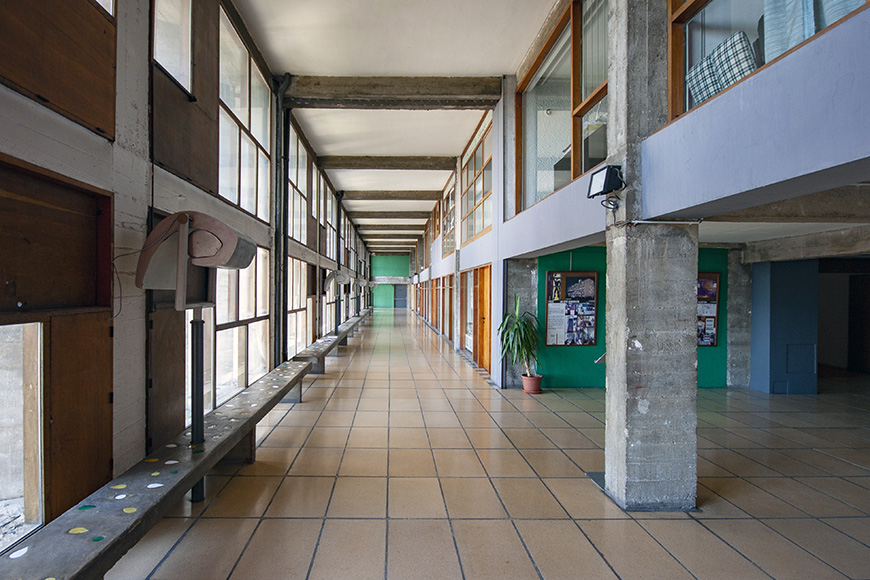
A communal staircase and a view of a communal corridor; photo Wojtek Gurak (CC BY-NC 2.0).

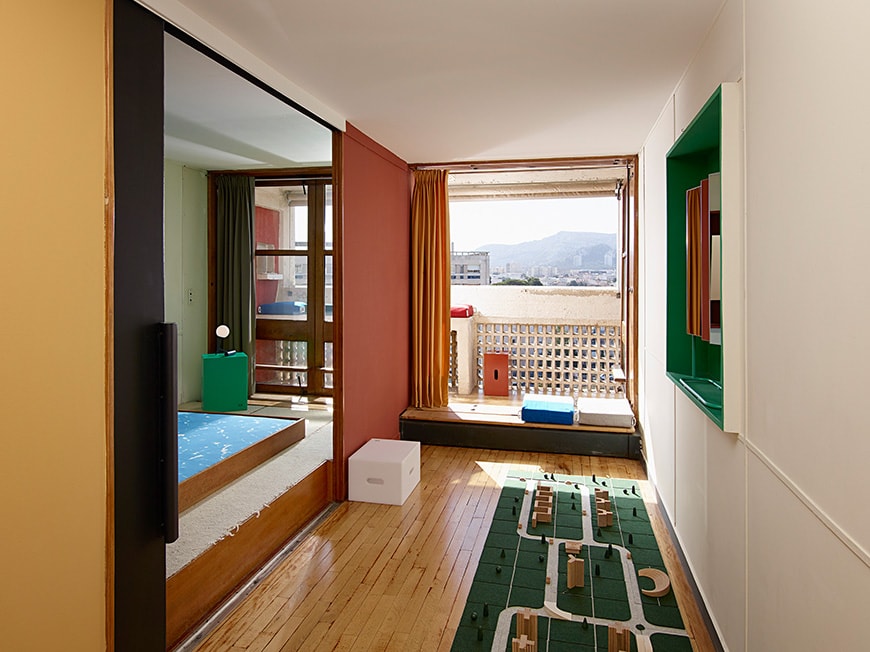

Unité d’Habitation Marseille, interior views of one of the apartments open to the public during the exhibition “ECAL Appartement 50”, 2015; photos Michel Bonvin courtesy of The École cantonale d’art de Lausanne.
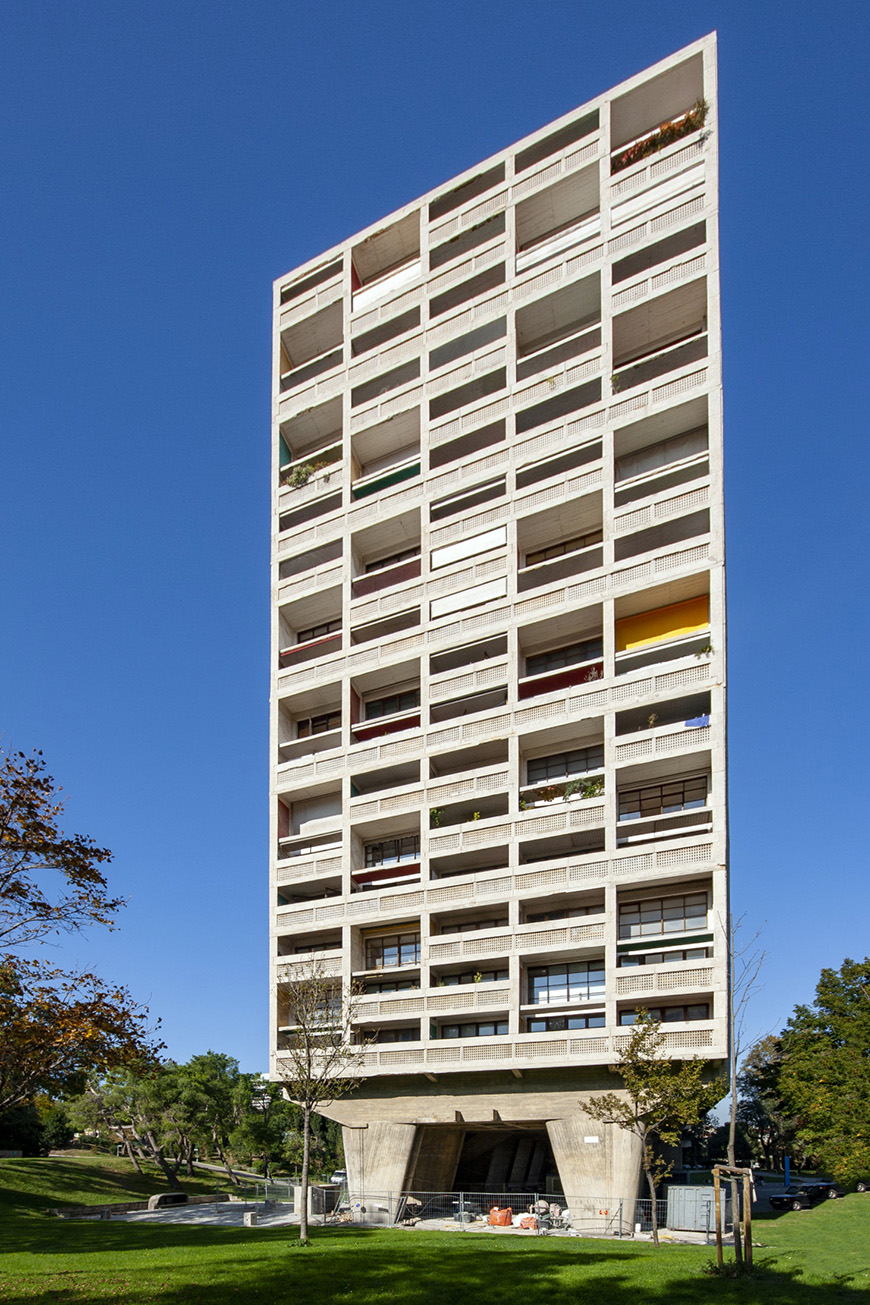
The south facade; photo Wojtek Gurak (CC BY-NC 2.0) via Flickr.


copyright Inexhibit 2026 - ISSN: 2283-5474
