
Le Corbusier – Monastery of Sainte Marie de la Tourette, Éveux, France
Auvergne-Rhône-Alpes, France
Phone: +33 (0)4 72 19 10 90
Website: https://www.couventdelatourette.fr/
How our readers rate this museum (you can vote)

 (2 votes, average: 4.50 out of 5)
 Loading...
Sainte Marie de la Tourette is a Dominican monastery in Éveux, a village about 25 kilometers (16 miles) northwest of Lyon, designed by Le Corbusier in 1953.
Commonly referred to simply as “La Tourette,” the convent is one of the architect’s most iconic postwar works. Since 1970, it has been open to the public for guided tours and overnight stays.
Cover image: view of the cloister of Sainte Marie de la Tourette. Photo: Aurelien Guichard CC BY-SA 2.0 via Flickr
History
Like the Notre Dame du Haut Chapel in Ronchamp, Sainte Marie de la Tourette is set on a hillside amid pastoral countryside in south-central France. The friars purchased the site in November 1943, intending to relocate from Chambéry to the Lyon area.
In February 1953, the Dominican brothers commissioned Le Corbusier – then 65 years old – to design the new monastery (technically a priory, headed by a prior). Their choice was influenced by Father Marie-Alain Couturier, who had collaborated with Le Corbusier at Ronchamp and championed the dialogue between religion and modern architecture.
Construction began in 1956, and the monastery was officially inaugurated on October 19, 1960, after 75 friars had already moved in. Sainte Marie de la Tourette was listed as a historic monument in 1979. Today, only seven Dominican friars reside there permanently.

View of Sainte Marie de la Tourette from the south. Photo: Antonio Gallud CC BY-SA 2.0 via Flickr
Architecture
Le Corbusier’s design was shaped by monastic precedents, including the Galluzzo Charterhouse in Florence (which he visited in 1907) and the Cistercian Abbey of Thoronet in Provence, explicitly suggested by Father Couturier in 1953.
As in other Dominican monasteries, the complex is organized around a central cloister. Le Corbusier initially proposed placing the cloister on the roof, but the friars opposed the idea. Externally, the building resembles a massive concrete block topped by a green roof. Set on a steep slope, it is raised on pilotis, preserving the hillside’s profile and visually thrusting the structure skyward.
The ensemble consists of a detached volume housing the church to the north, and a large C-shaped building containing the refectory, kitchen, chapter house, small oratory, library, reading rooms, infirmary, classrooms, meeting rooms, and one hundred friars’ cells. A cross-shaped covered passage traverses the courtyard, linking the main functional spaces.
Each friar’s cell measures 5.92 × 1.83 meters (19.4 × 6 feet), with a ceiling height of 2.26 meters (7.4 feet), and includes a small outward-facing balcony.
The church is the most monumental space: a large rectangular hall with the altar and sanctuary raised several steps above the nave. Horizontal openings admit light into the hall. A curvilinear side chapel, lit by three circular skylights, and a rectangular sacristy flank the main hall to the north and south.

Close‑up of the west façade, showing the balconies of the friars’ cells on the two upper floors. Photo by Andrew Carr, CC BY-NC-ND 2.0 via Flickr

Slanted reinforced‑concrete columns supporting the main building. Photo: Archigeek, CC BY-NC-ND 2.0 via Flickr

One of the corridors of the cloister. Photo: Wsifrancis CC BY-NC-ND 2.0 via Flickr

View of the west façade of the priory. Photo by Andrew Carr, CC BY-NC-ND 2.0 via Flickr

At La Tourette, all volumes are topped with green roofs. Photo: Aurelien Guichard, CC BY-SA 2.0 via Flickr
Principles of Design
Le Corbusier’s conception of La Tourette reflects three fundamental Dominican principles: silence, poverty, and preaching.
- Silence was achieved through the monastery’s secluded location and an architecture conducive to introspection. As Father Irenaeus Dunlevy wrote: “The priory must be a silent vessel for the interior life of the friar, while the world scratches at its walls.” (from Dominican Form and Architecture: Tensions by Father Irenaeus Dunlevy, Domenicana Journal, December 2010)
- Poverty is expressed in the austere materials, especially the extensive use of raw concrete inside and out.
“The tension of poverty does not spring from the demands of life, but from resisting the world. The design of the priory then can be seen as contributing to the life of poverty or detracting from it.” (ibid.) - Preaching is encouraged by the spatial layout, developed in close collaboration with Father Couturier, by the masterful use of natural light, and by subtle references to Dominican tradition—such as the pyramid-shaped roof of the small oratory on the west side of the courtyard.
“Throughout the 800 years of the Order, there are numerous examples of well-designed priories that borrow designs from one another. A prospective architect designing a Dominican priory in the 21st century would do well to glean ideas from existing priories because successful solutions to these difficult tensions are likely built already.“ (ibid.)
Le Corbusier interpreted these principles creatively rather than literally. He evoked stained glass by painting the splays of the church openings in red, yellow, and blue. He also reimagined the cloister walkway, transforming it into two intersecting corridors across the courtyard.
This sensitivity to religious themes may seem surprising in an avowed nonbeliever, yet it reveals the profound, unconventional spirituality evident in other works, such as Ronchamp and his original design for the Church of Saint-Pierre in Firminy.
“I am not a churchgoer myself, but one thing I do know is that every man has the religious consciousness of belonging to a greater mankind, to a greater or lesser degree, but in the end, he is part of it. Into my work, I bring so much effusion and intense inner life that it becomes something almost religious.” Le Corbusier
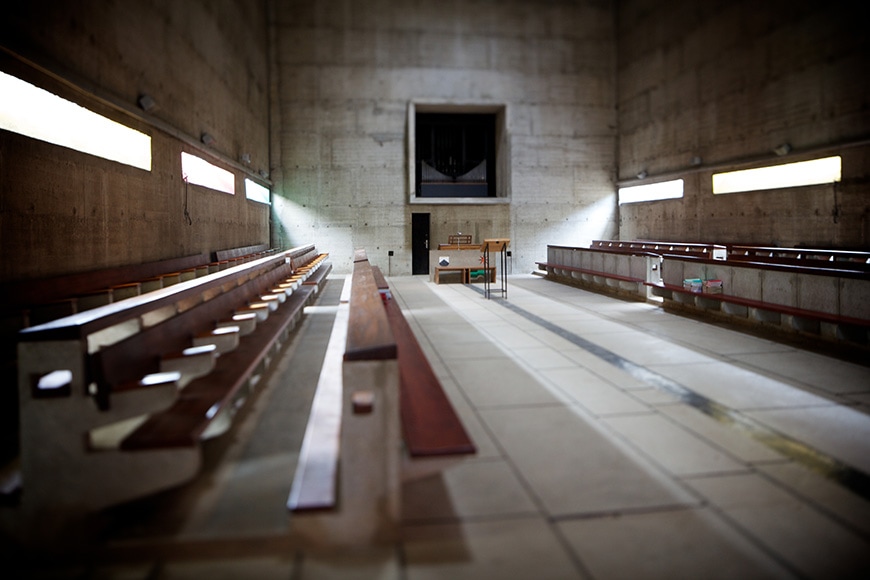
Interior view of the church from the raised sanctuary. Photo by Aurelien Guichard CC BY-SA 2.0 via Flickr
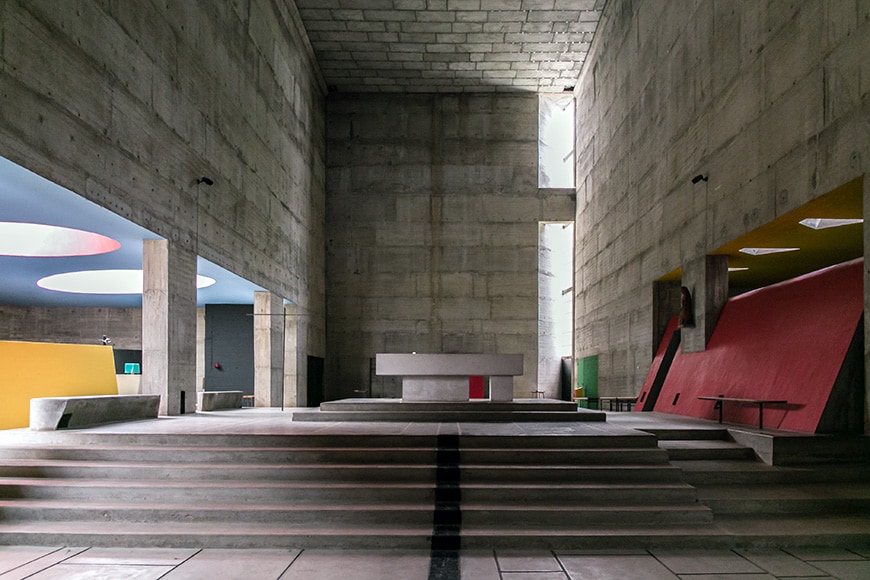
View of the church interior toward the high altar, with the side chapel on the left and the sacristy on the right. Photo: Wsifrancis CC BY-NC-ND 2.0 via Flickr
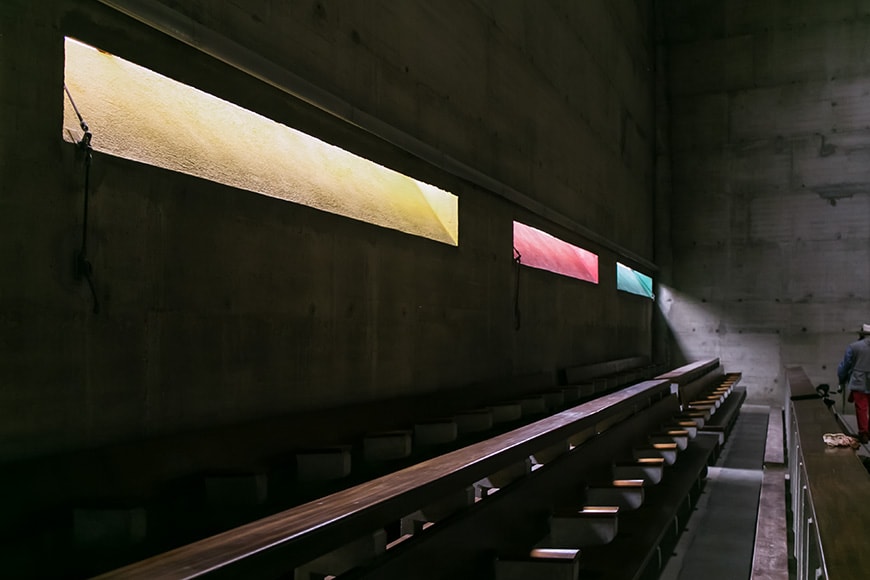
Painted splays in red, yellow, and blue recall the stained glass of medieval abbeys. Photo: Wsifrancis CC BY-NC-ND 2.0 via Flickr
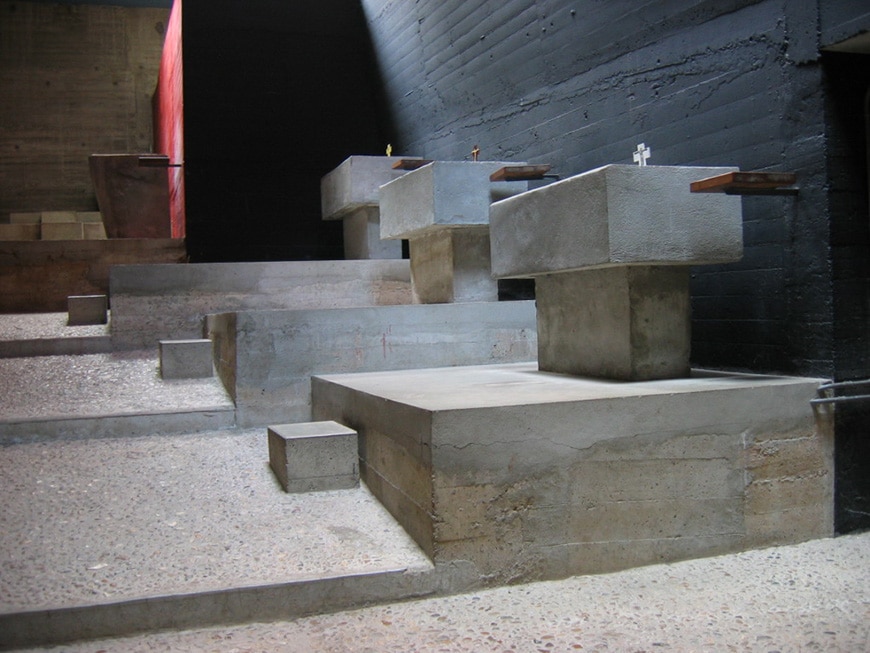
View of the side chapel from the lower level. Photo by Minke Wagenaar, CC BY-NC-ND 2.0 via Flickr

View of the refectory from the sanctuary. Photo: Fred Romero CC BY 2.0 via Flickr
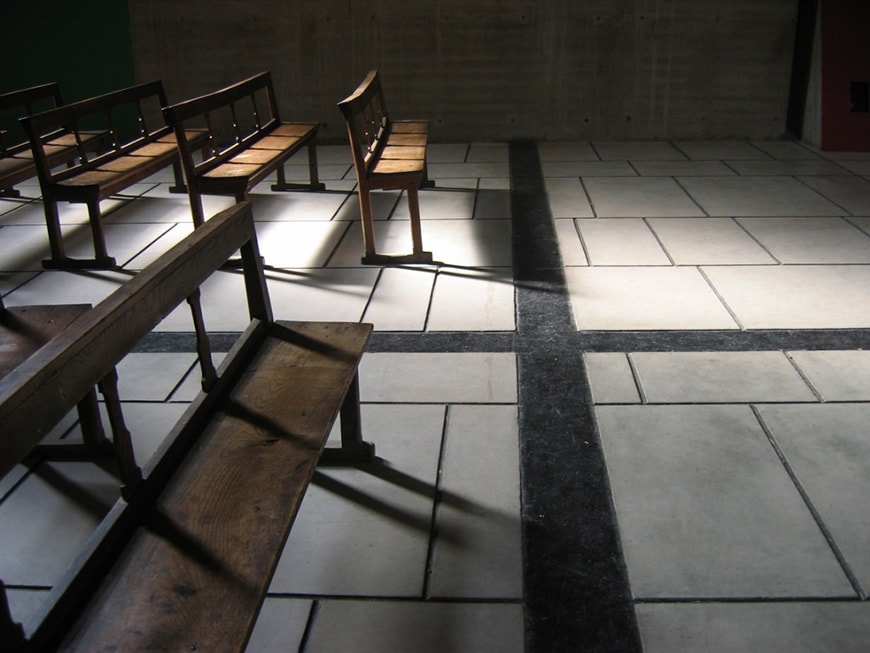
Close‑up of the stone‑clad church floor. Photo: Minke Wagenaar CC BY-NC-ND 2.0 via Flickr
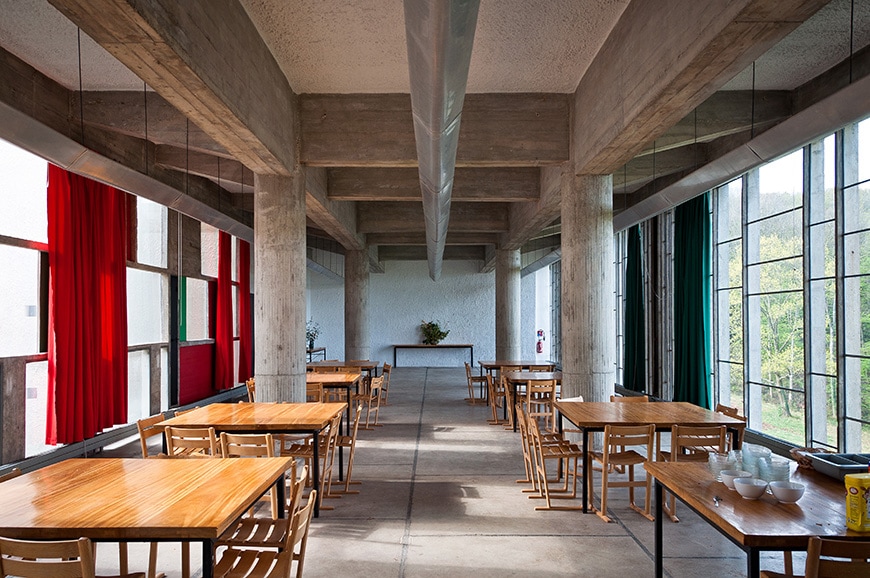
The refectory. Photo: Archigeek CC BY-NC-ND 2.0 via Flickr
Visiting La Tourette
Although still functioning as a monastery, La Tourette is largely empty due to the decline in the number of monks.
To sustain the site, part of the friars’ cells has been converted into guest rooms. Visitors can stay overnight at modest rates, with dinner and breakfast included.
Guided tours of the interior are offered Monday through Saturday, lasting about 90 minutes. Group visits must be booked in advance.

Detail of the concrete parapet on a cell balcony. Photo: Ilha Lee CC BY-NC 2.0 via Flickr

Photo by Fred Romero, CC BY 2.0 via Flickr

copyright Inexhibit 2026 - ISSN: 2283-5474
