
What to expect from the 2026 Venice Art Biennale
What to expect from the 2026 Venice Art Biennale

The 61st International Art Exhibition of the Venice Biennale, titled “In Minor Keys” – opening on May 9 and running until November 22, 2026 – already promises, for many reasons, to be an unusual edition.
The circumstances surrounding it are, of course, particularly dramatic: the curator, Koyo Kouoh, passed away suddenly in May 2025, one year before the exhibition’s opening.
By that time, Kouoh had already selected both the theme and the artists who would take part in the curator’s exhibition. The main guidelines for the installation, as well as its designers—the South African firm Wolff Architects—had also been defined.
It is, however, difficult, if not impossible, to know which further developments and ideas were lost with the curator’s passing. One direct consequence is already clear: this year, the Golden Lion for Lifetime Achievement will not be awarded, as the curator left no indication regarding her choice. But other elements make the anticipation surrounding the 2026 Biennale both compelling and, in some respects, potentially controversial.
Above: the official banner image of the 61st Art Exhibition of la Biennale di Venezia. Courtesy of La Biennale di Venezia.
Russia: yes or no?
The controversy was ignited by the announcement from the President of the Venice Biennale, Pierangelo Buttafuoco, that Russia would be readmitted to the event after four years of forced absence following the invasion of Ukraine. The decision was openly criticized by several European countries and even by the Italian government itself, which attempted to dissuade the President—appointed by the current government in 2023—from moving forward.
At the same time, some have promised to organize “counter-exhibitions” showcasing dissident art opposed to the current Russian regime, recalling the famous 1977 edition of the Art Biennale, remembered as the “Biennale of Dissent,” which openly criticized state-sponsored art from the USSR and the communist bloc. As of now, it remains unclear whether Russia will participate and who might be hosted in the official pavilion at the Giardini.
The trouble with Israel
Israel’s participation in the 2026 Art Biennale has also sparked debate and strong reactions. After news circulated in January that the Israeli Pavilion would reopen (it had remained closed during the previous Art Biennale), a series of statements followed. Finally, in mid‑March, Anga – Art Not Genocide Alliance published an open letter addressed to the President of the Biennale.
Signed by 187 artists, curators, and art professionals, the letter forcefully challenges Israel’s presence at the Venetian event and reaffirms support for “our fellow artists and cultural workers in Palestine, in solidarity with Palestine.” Among the signatories are several of the artists invited to exhibit in this edition’s curator’s show.
It now seems certain, however, that this year Israel will not exhibit in the official Pavilion at the Giardini but rather at the Arsenale.
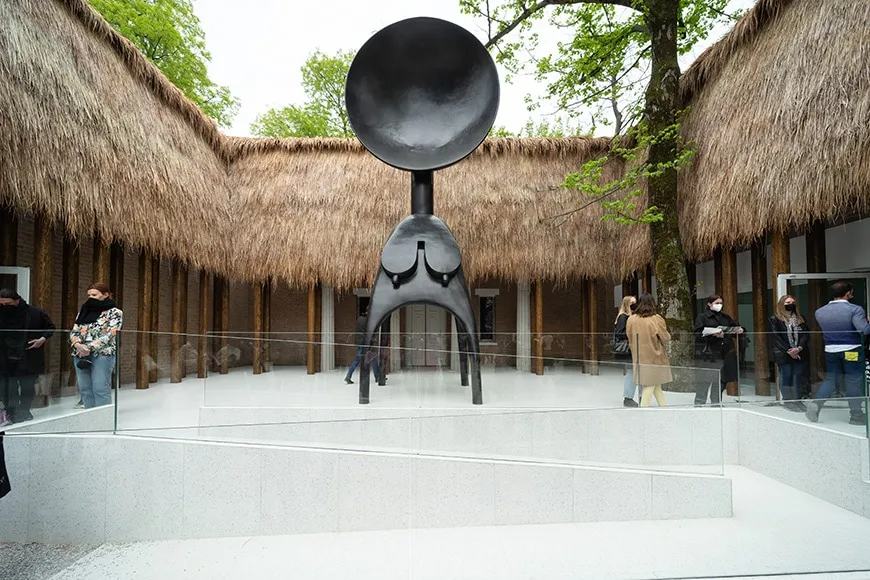
The United States pavilion at the 2022 Art Biennale. Photo © Riccardo Bianchini/ Inexhibit
The United States Pavilion
The circumstances under which the U.S. Department of State took control of the selection process for its pavilion – normally overseen by an independent organization, the NEA (National Endowment for the Arts) – together with the withdrawal of curator John Ravenal and the invited artist Robert Lazzarini, and their replacement by Alma Allen and Jeffrey Usli as curator, have added further layers of debate to a situation that some believe is influenced by President Trump’s particular relationship with the arts.
Lazzarini’s project revolved around a series of sculptures depicting flags, a Civil War cannon, a statue of George Washington, and a large eagle: various symbols of American identity distorted to represent the contradictions of the United States today. It is undeniably a vision that may not have appealed to the current administration, which is consistently seeking reaffirmation of its centrality on the world stage. Even accepting the official explanation that the withdrawal of the curator and artist was due to a lack of funding, it is clear that Allen’s biomorphic sculptures are far less contentious.
“In Minor Keys”: Koyo Kouoh’s Project
As many had hoped, the Biennale has decided that the exhibition will be guided by the project envisioned by Koyo Kouoh, on which she worked intensively together with the curatorial team that ultimately brought it to completion.
In the curator’s introduction, the meaning of the exhibition is articulated through two main concepts. The first is borrowed from music and evokes minor keys: Kouoh refers to the need to attune ourselves to the frequencies of minor tonalities as a metaphor for artistic, social, educational, and poetic practices that stand apart from the deafening cacophony surrounding us.
Kouoh wrote: “The minor keys refuse orchestral bombast and goose-step military marches and come alive in the quiet tones, the lower frequencies, the hums, the consolations of poetry (…) The minor keys ask for listening that calls on the emotions and sustains them in return.”
The second image the curator proposes is that of minor islands, seen as oases of diversity, cultural richness, and vibrant social life. This reflection also incorporates a critique of power and mainstream culture, which for too long have ignored and marginalized local knowledge, treating artisanal practices as destined merely to satisfy decorative or devotional needs. On this point, the curator writes: “The “civilising mission” flattens all with condescending contempt, and in the contemporary era entire societies and ecologies are regarded as collateral damage in the headstrong pursuit of growth supported by ruthlessness and greed.”
The realization of the Exhibition was made possible thanks to the work of the curatorial team selected by Koyo herself: Gabe Beckhurst Feijoo, Marie Hélène Pereira, and Rasha Salti (advisors); Siddhartha Mitter (editor‑in‑chief) and Rory Tsapayi (research assistant).
The remote work carried out through online meetings, combined with in‑person seminars held in Venice in May and October 2025 and in Dakar in June 2025, enabled the curatorial team -spread across multiple continents – to collaborate closely with the Biennale. This process gave rise to an intense and shared workflow in which every contribution enriched the collective construction of the Exhibition.
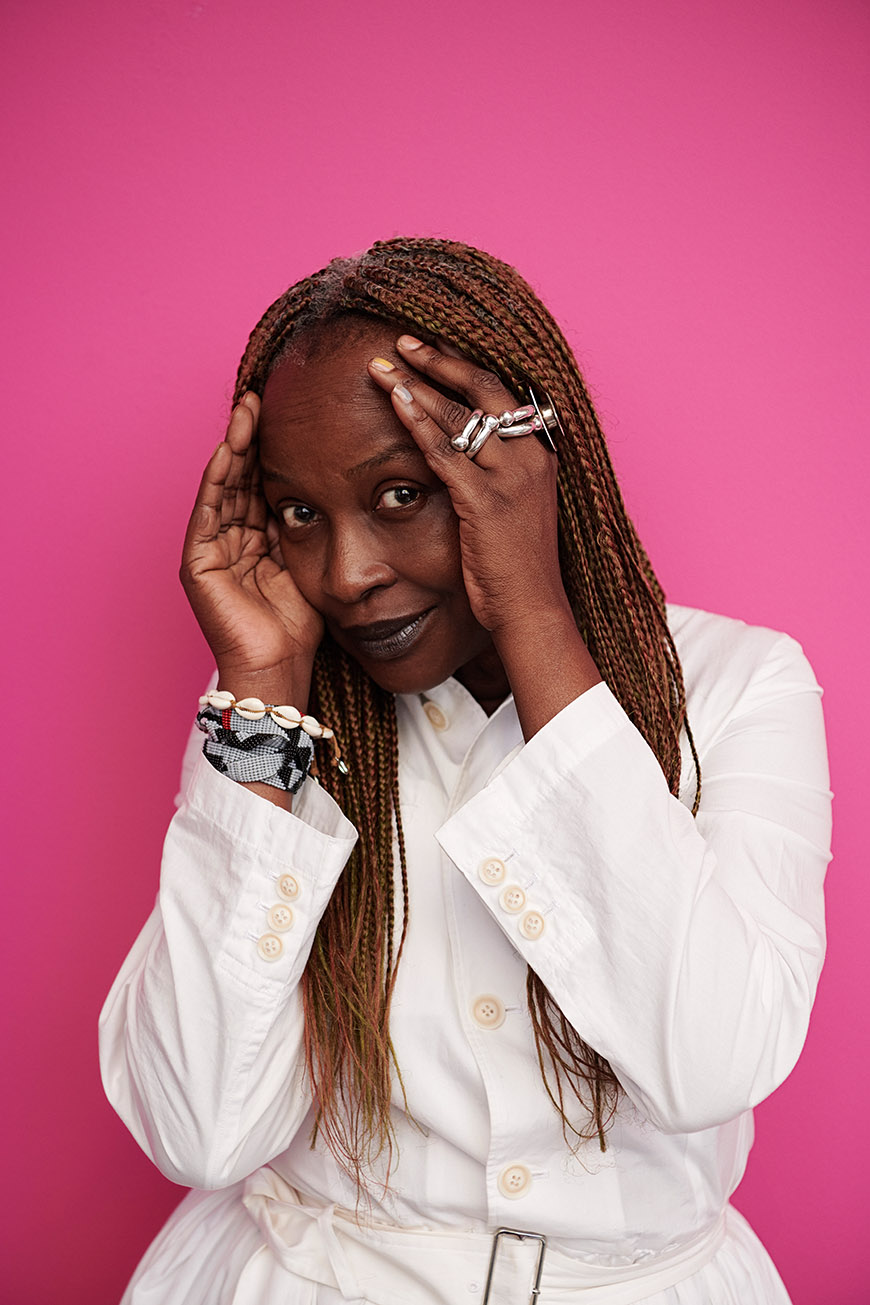
A portrait of Koyo Kouoh. Photo © Mirjam Kluka, courtesy of la Biennale di Venezia.
The Exhibition Design
The installation of the curator’s Exhibition, in the Central Pavilion at the Giardini and at the Arsenale, was entrusted by Koyo Kouoh to the Cape Town–based studio Wolff Architects. The project translates the curator’s concept into a language built around the idea of thresholds:
“Sweeping indigo textile banners descend from the rafters to graze the floor, marking subtle transitions between atmospheres. These vertical thresholds signal shifts in cadence—closing one spatial movement while opening another—inviting visitors to slow down and cross into distinct yet interconnected artistic universes.” (Wolff Architects)
The participants in the curator’s exhibition
There are 111 participants in this Biennale – artists, collectives, and organizations – from a wide range of geographical contexts, selected by Koyo with an emphasis on resonances, affinities, and potential convergences between practices that may be far apart. By observing realities active in different parts of the world, the Curator imagined how the ingenuity and experimental drive of each participant might intersect with those of other artists and movements, even without direct connections. In Minor Keys, thus, seeks to reflect and expand the relational geography woven over a lifetime and grounded in encounter.
Examining the participants’ origins reveals some aspects that may be interesting—or perhaps simply curious. The most represented continent is Africa, with 28 participants. North America follows, almost entirely due to the presence of U.S. artists (except for two Canadians) and, interestingly, no Mexicans. There are twenty Asian artists, though most come from the Middle East; artists from East Asia are few, and notably, there are no Chinese participants. The presence of artists from Central and South America is respectable, totaling 17. Finally, 20 artists were born in Europe, but among them, there are, for example, no Spaniards, no Scandinavians, and no artists from Eastern Europe.
Lastly, there is no artist born in Italy in the curator’s exhibition—an absence that has not gone unnoticed and has inevitably raised questions about the health of the contemporary art system in the country that has hosted the Venice Biennale for 131 years.
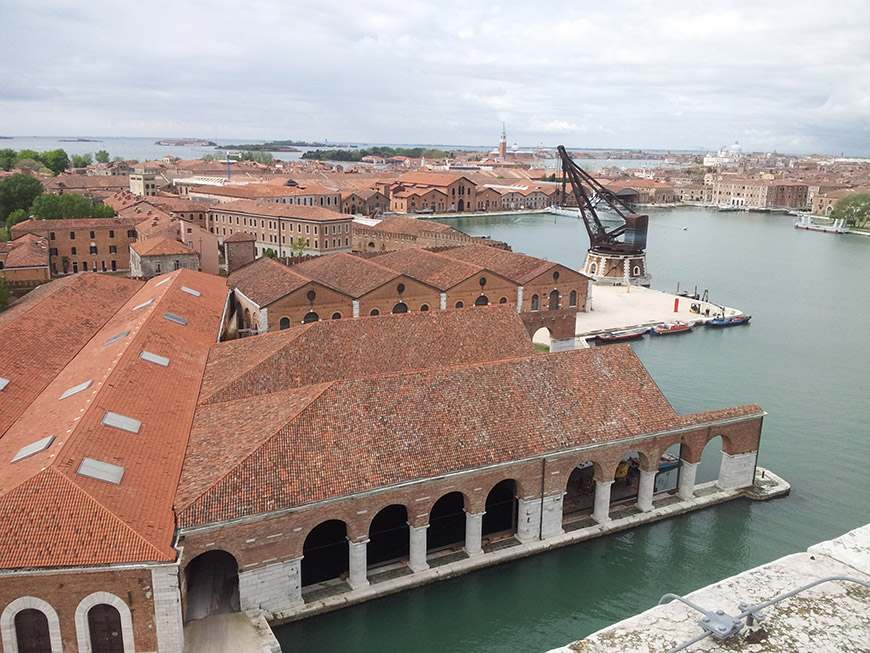
An aerial view of the Venice Arsenal. Photo © Andrea Avezzù, courtesy of la Biennale di Venezia.

copyright Inexhibit 2026 - ISSN: 2283-5474
