
Saint Peter’s Basilica, Vatican City/Rome
Lazio, Vatican
How our readers rate this museum (you can vote)
 (3 votes, average: 5.00 out of 5)
 Loading...
Saint Peter’s Basilica—formally known as The Papal Basilica of Saint Peter in the Vatican—is the largest and most significant Roman Catholic church in the world. Open daily, it is a monumental Renaissance and Baroque masterpiece that houses countless works of art. The basilica stands within Vatican City, an independent city-state entirely surrounded by Rome in central Italy.
Above: The basilica’s monumental Baroque façade on Saint Peter’s Square, designed by Carlo Maderno and completed in 1614; photo by Warren LeMay via Flickr (CC0 1.0)
History and architecture
The basilica as we know it today is the result of a 1,600‑year evolution, during which it was built, destroyed, rebuilt, expanded, and altered many times. The “modern” Saint Peter’s Basilica was conceived in the early 16th century, when Pope Julius II resolved to replace the original basilica, constructed by Emperor Constantine in the 4th century CE on what was believed to be the burial site of Saint Peter. By the 15th century, the old structure had fallen into disrepair, prompting the Pope to commission a new, monumental church.
The first architect was Donato Bramante, but after his death in 1514, the project passed to Raphael, Antonio da Sangallo the Younger, Michelangelo, Carlo Maderno, and finally Gian Lorenzo Bernini. The design underwent numerous revisions until the basilica was completed in 1626. Bernini later oversaw much of the interior decoration in the 17th century, while some marble embellishments were only finished in the 20th century.
Today, Saint Peter’s Basilica remains the world’s largest church. Its vast Latin‑cross plan is crowned by the imposing dome designed by Michelangelo and completed by Giacomo della Porta. The basilica covers 15,160 square meters (163,180 square feet), stretches 218 meters (720 feet) in length, and rises to 133 meters (448 feet) in height. Its interior volume—about 1.3 million cubic meters—is so immense that London’s St. Paul’s Cathedral could fit inside it eight times. The church can accommodate more than 20,000 people.

View of the basilica from Via della Conciliazione in Rome, with the dome designed by Michelangelo around 1550 and completed by Giacomo della Porta in 1590; photo Anthony G. Reyes via Flickr (CC BY-ND 2.0).
Architecturally, the basilica is a compendium of Italian design from the late Renaissance to the Baroque. Its unusually broad Latin‑cross layout reflects the competing visions of successive architects, some favoring a Greek cross and others a Latin one. The double‑shell dome recalls, on a grander scale, Brunelleschi’s dome for Florence Cathedral, while Bernini’s interiors epitomize the Baroque style. The massive façade facing Saint Peter’s Square, designed by Carlo Maderno in the early 17th century, is often considered one of the less successful elements of the building.

Saint Peter’s Basilica at dusk, seen from the square; photo Dennis Jarvis via Flickr (CC BY-SA 2.0).
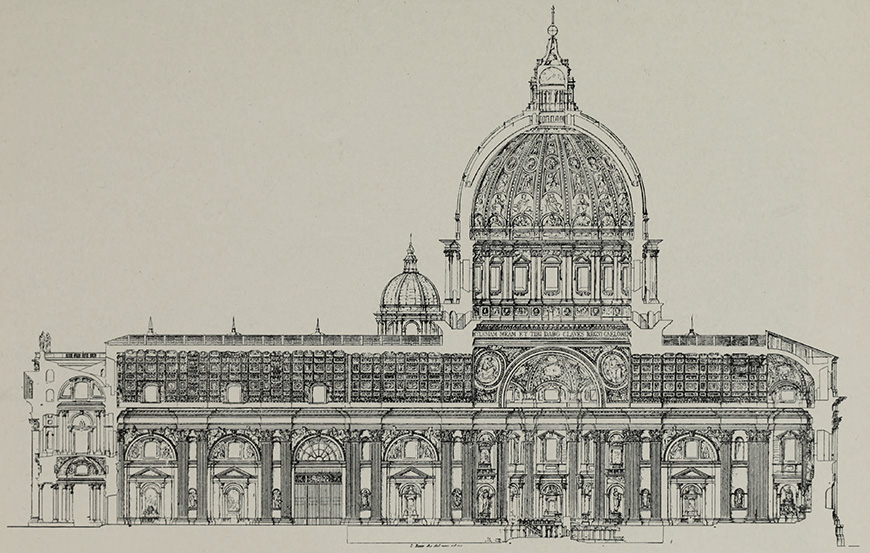
Longitudinal section of the basilica, showing the double‑shell dome—likely inspired by Brunelleschi’s dome of Florence’s Cathedral of Santa Maria del Fiore; image Internet Archive Book Images (Public Domain).

Eastern view of the church with the Egyptian obelisk in the foreground; photo Nicola via Flickr (CC BY 2.0)
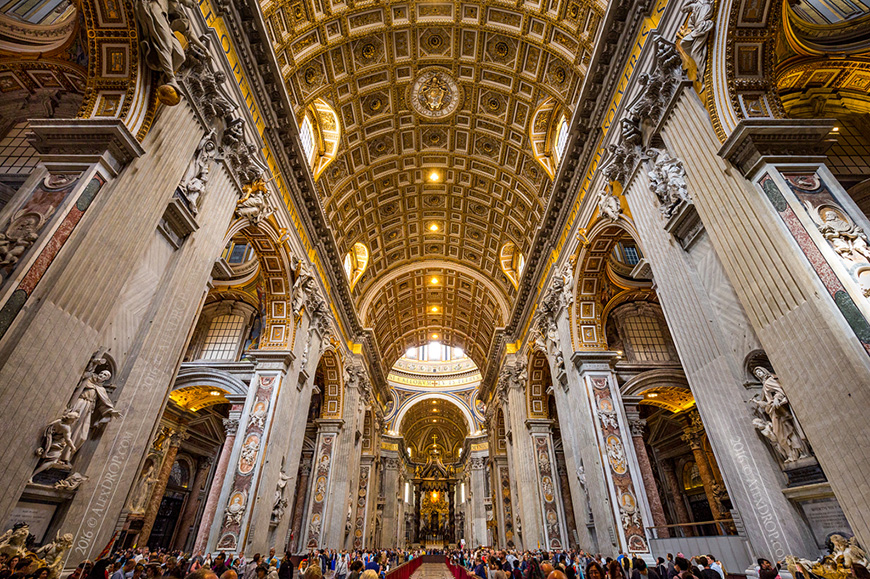
The central nave of the basilica; photo Alex DROP via Flickr (CC BY-NC-ND 2.0).
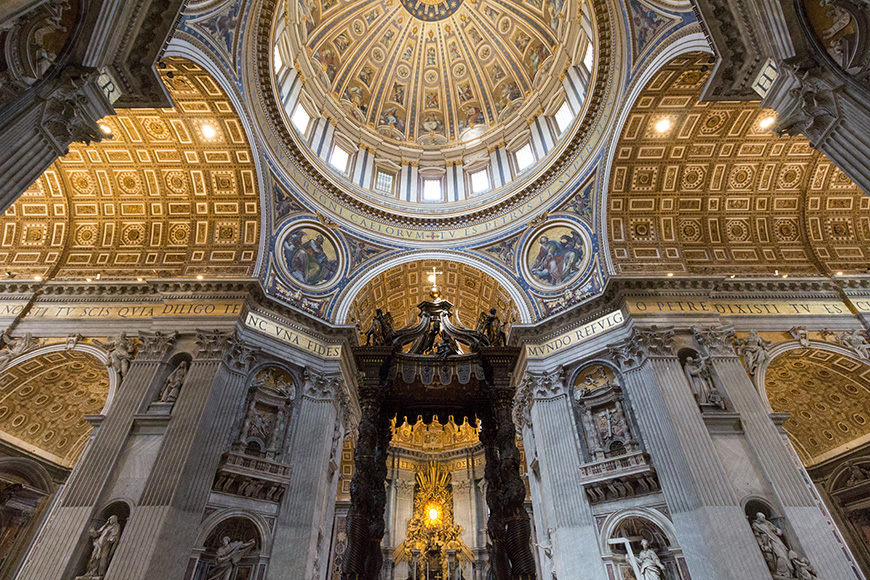
Interior view featuring Bernini’s bronze baldachin in the foreground, with Michelangelo’s dome rising above; photo Adam Lusch via Flickr (CC BY-SA 2.0).

Close‑up of Michelangelo’s dome from inside the church, its inner surface adorned with mosaics created by various artists in the early 17th century; photo Slices of Light via Flickr (CC BY-NC-ND 2.0)
The Vatican Grottoes
The new basilica was constructed directly above the foundations and pavement of the original Constantinian church. Between the two levels lies a network of underground chambers and corridors known as the Grotte Vaticane (Vatican Grottoes). Richly decorated, these spaces house the tombs of 91 Popes as well as the revered tomb of Saint Peter himself.

The tomb of Saint Peter in the Vatican Grottoes, a complex of underground chambers beneath the basilica; photo by Kevin Gessner via Flickr (CC BY 2.0)
Saint Peter’s Square
Although not technically part of the basilica, the celebrated Piazza San Pietro forms an integral complement to its architecture. Designed by Bernini and completed in 1667, the square is framed by a monumental colonnade of 284 travertine Doric columns, surmounted by 140 statues of saints. At its center stands an ancient Egyptian obelisk, 25.3 meters (83 feet) high.
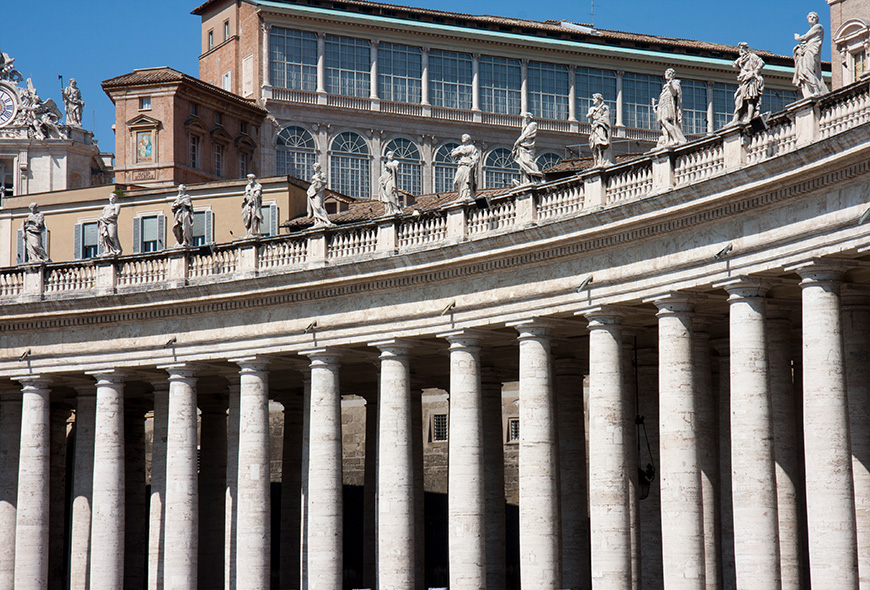
Detail of Bernini’s celebrated colonnades in Saint Peter’s Square, topped with 140 statues of saints and completed in the mid‑17th century; photo Nathan Rupert via Flickr (CC BY-NC-ND 2.0).
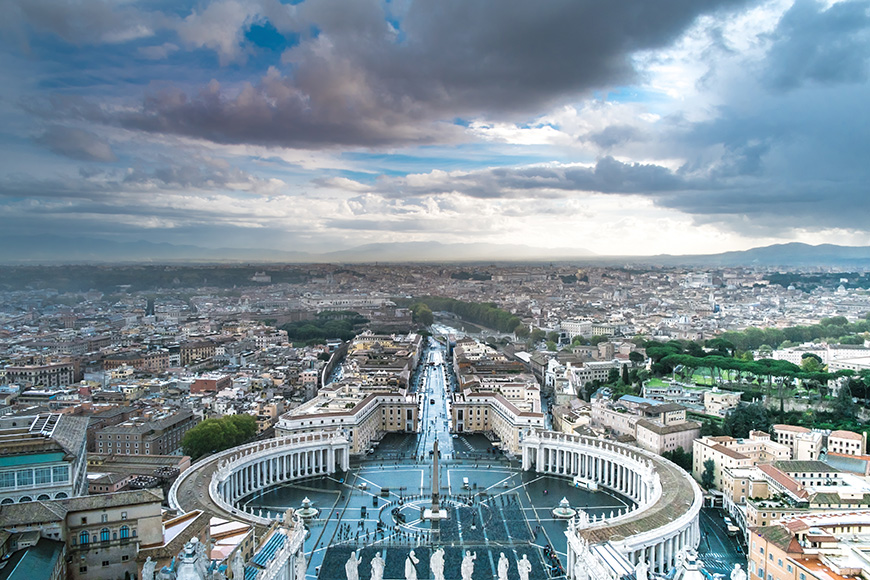
Aerial view of Saint Peter’s Square; photo R. Halfpaap via Flickr (CC BY-ND 2.0)
Artworks
Saint Peter’s Basilica is home to numerous masterpieces. Among the most famous is Michelangelo’s Pietà, sculpted between 1497 and 1499, located in the north aisle.
Other highlights include Bernini’s bronze canopy over the high altar, his many Baroque sculptures, Antonio Canova’s Monument to Clement XIII, Arnolfo di Cambio’s bronze statue of Saint Peter, Pollaiuolo’s Tomb of Pope Innocent VIII, and a baptismal font fashioned from the lid of Emperor Hadrian’s sarcophagus.
Paintings are rare within the basilica, as most were replaced in the 18th century with mosaic reproductions for durability. One of the finest examples is the mosaic replica of Raphael’s Transfiguration, the original of which is displayed in the nearby Vatican Museums.
Visiting
Entry to Saint Peter’s Basilica is free of charge. However, visitors are strongly advised to book a guided tour with a reserved time slot to avoid long queues at the entrance.
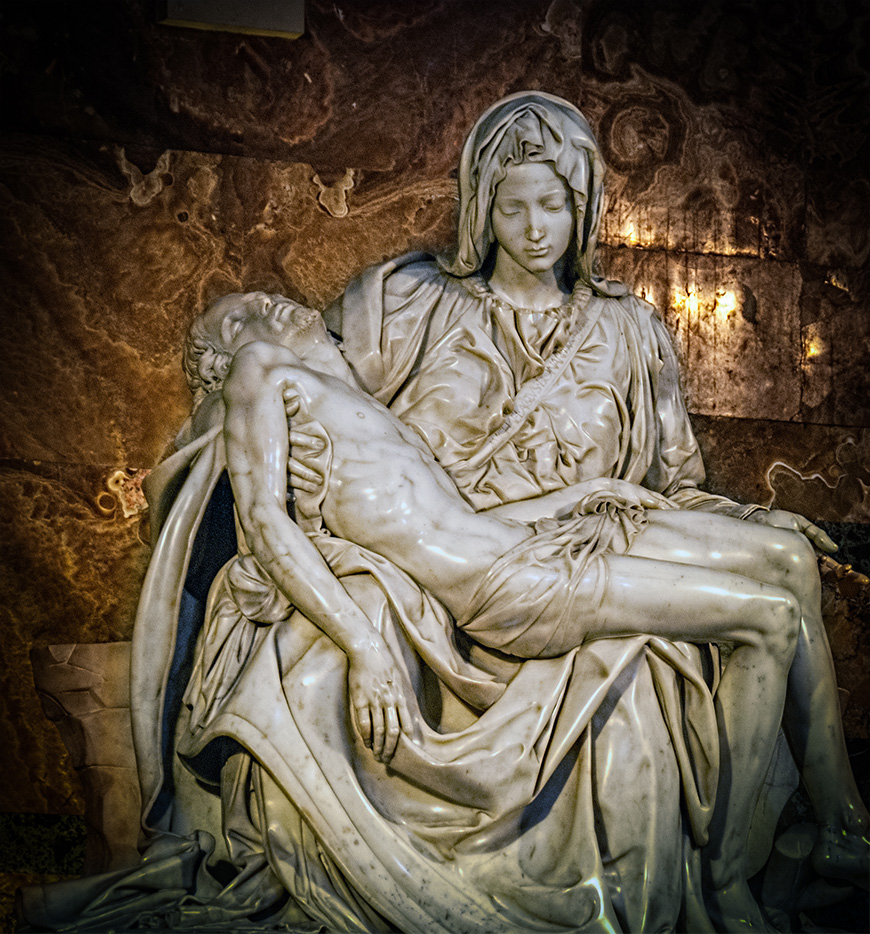
Michelangelo’s Pietà in Saint Peter’s Basilica, sculpted between 1497 and 1499 when the artist was in his early twenties; photo by Gary Campbell-Hall via Flickr (CC BY 2.0).
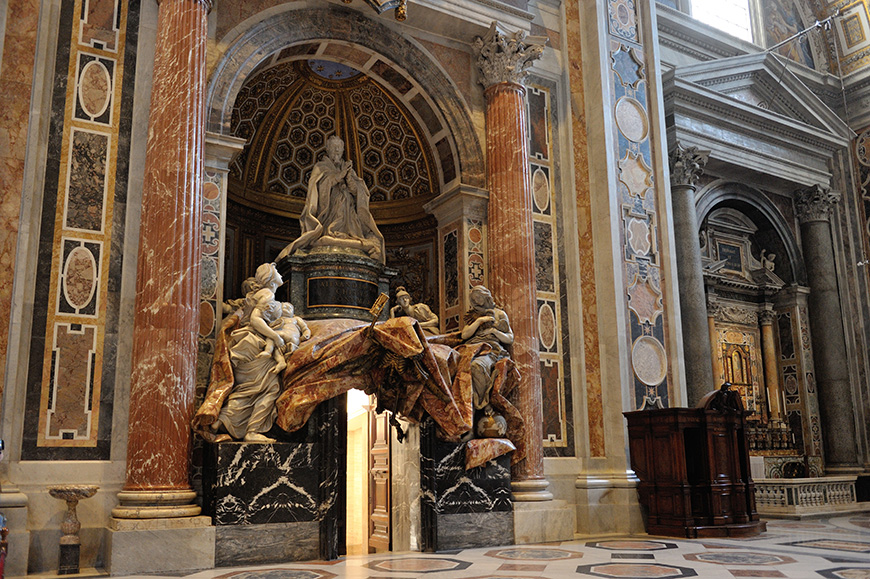
The tomb of Pope Alexander VIII, created by Gian Lorenzo Bernini between 1671 and 1678; photo by Rog01 via Flickr (CC BY-NC-ND 2.0).
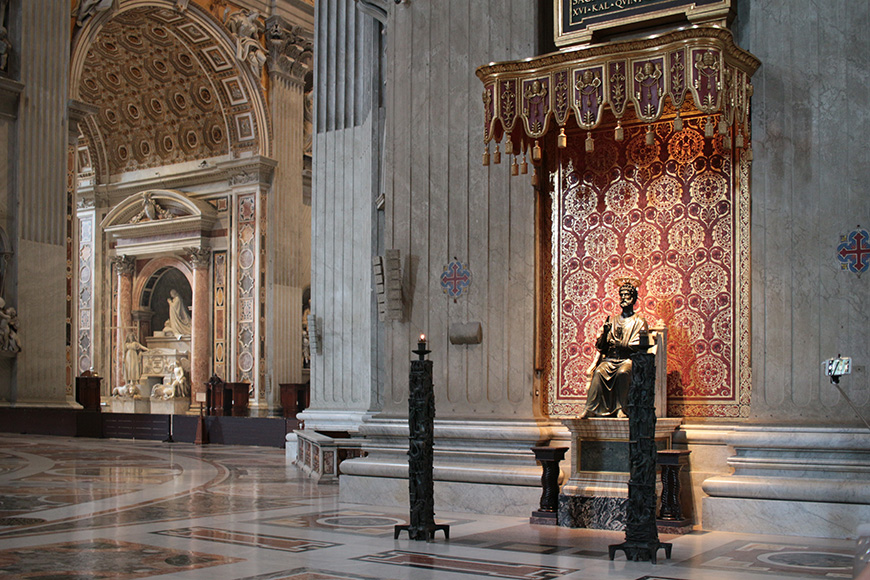
Interior view of the basilica with Arnolfo di Cambio’s 13th‑century bronze statue of Saint Peter on the right; photo by Binary Koala via Flickr (CC BY-SA 2.0).
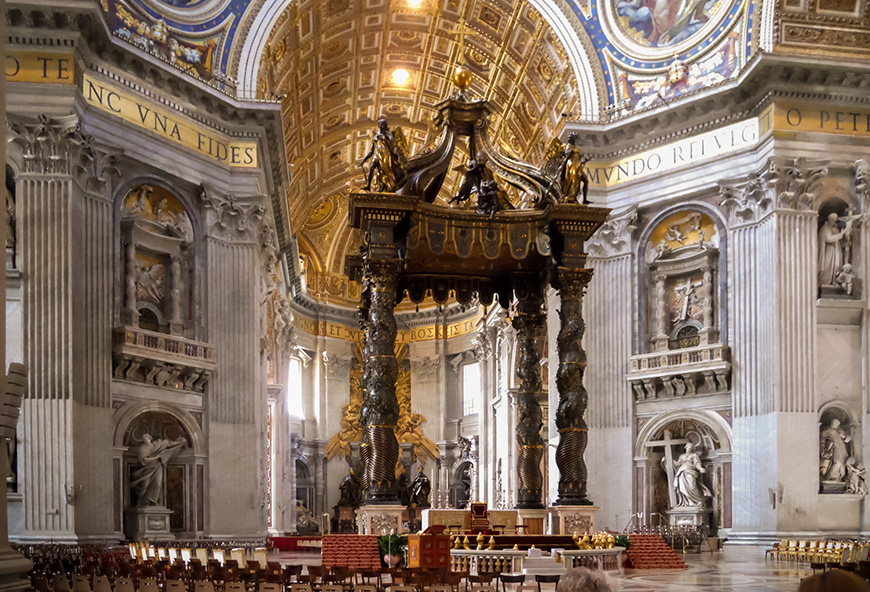
Bernini’s baldachin over the main altar, a monumental Baroque bronze canopy supported by four 36‑foot‑high twisted columns, designed in the first half of the 17th century; photo by Erik Drost via Flickr (CC BY 2.0).

copyright Inexhibit 2026 - ISSN: 2283-5474
