

Highlights from Koyo Kouoh’s Main Exhibition at Venice Art Biennale 2026
This article is dedicated to the curator’s exhibition of the 61st International Art Exhibition of La Biennale di Venezia, titled In Minor Keys. As always (except for the 2025 Architecture Biennale, when the Central Pavilion in the Giardini was closed for renovation), the main exhibition is divided into two sections: one hosted in the Central Pavilion at the Giardini di Castello, and the other installed in the Corderie of the Arsenale. We discussed the general theme of the 61st Art Biennale in this article published on Inexhibit a few weeks ago.
I decided to publish images of both venues in a single post because they form a unified project articulated through the work of the artists selected by curator Koyo Kouoh—who passed away in May of last year—and her curatorial team.
The exhibition is well structured and rich in diverse voices. Yet while the Corderie at the Arsenale naturally shapes a defined path, the Giardini do not offer a single route to follow. Instead, visitors are invited to construct their own itinerary, guided by suggestions that evoke nature, family ties, craft-based making, and memory.
The 111 participants—artists, collectives, and organizations—come from many regions of the world. The curators emphasized Koyo’s attention to resonances and affinities, and her ability to trace convergences among artists and their experimental practices. The exhibition aims to convey to visitors the relational geography imagined by Koyo, shaped by encounters cultivated over a lifetime.
GIARDINI
Otobong Nkanga – Soft Offerings to Silenced Voices and to All Who Have Turned to Dust, 2026
In her site-specific installation, Otobong Nkanga has clad the four large entrance columns of the Central Pavilion in the Giardini with bricks, to which she attached ceramic vessels that host climbing plants. As these plants grow over the course of the Biennale, they will eventually envelop the columns entirely.
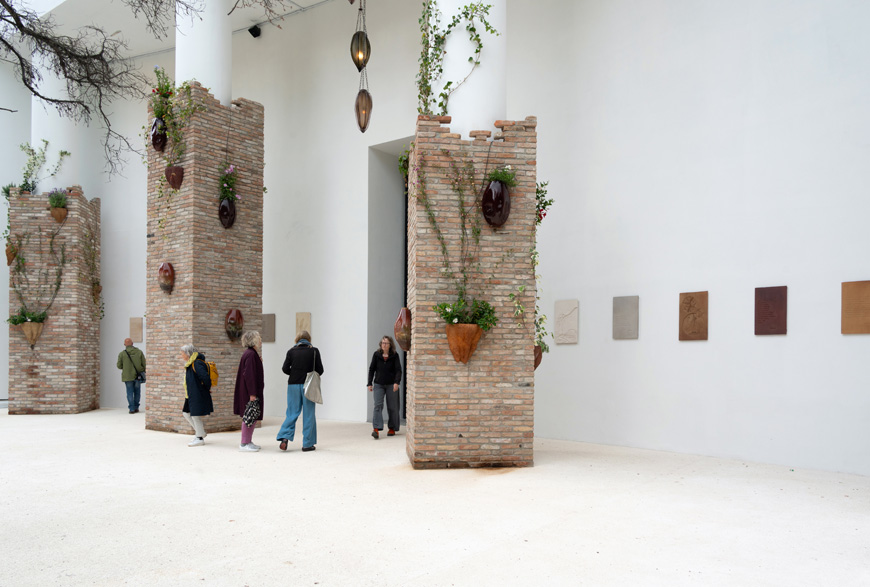
Otobong Nkanga – Soft Offerings to Silenced Voices and to All Who Have Turned to Dust; photo © Riccardo Bianchini, Inexhibit 2026
Seyni Awa Camara – Various works, 2015–2025
The terracotta sculptures by the late Senegalese artist Seyni Awa Camara depict mysterious anthropomorphic beings inhabiting the threshold between magic and materiality, between dream and physical reality.
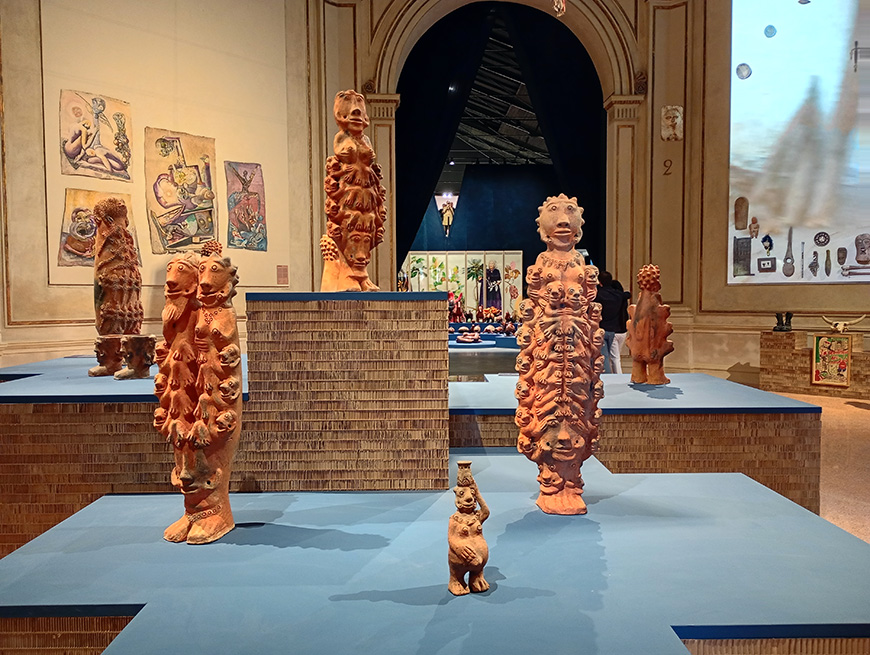
Seyni Awa Camara, installation view; photo © Federica Lusiardi, Inexhibit 2026
Celia Vásquez Yui – The Council of the Mother Spirits of the Animals, 2020–2023
At the 2026 Biennale, Peruvian artist and activist Celia Vásquez Yui presents a work in which a group of zoomorphic ceramic creatures gathers in a circle around a serpent, as if convened in an assembly. The creatures look at us just as we look at them, engaging in a shamanic exchange aimed at restoring collective and environmental well‑being.
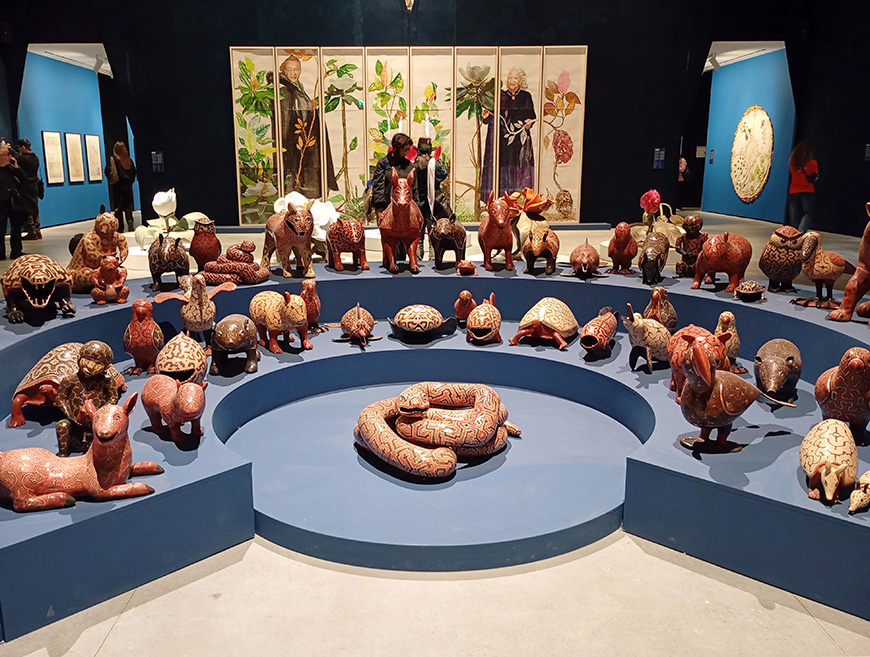
Celia Vásquez Yui – The Council of the Mother Spirits of the Animals; photo © Federica Lusiardi, Inexhibit 2026
María Magdalena Campos-Pons with Kamaal Malak – Anatomy of the Magnolia Tree for Koyo Kouoh and Toni Morrison, 2026
In her installation, developed in collaboration with musician Kamaal Malak, the Cuban-born artist Campos-Pons places eight large panels—combining floral imagery with portraits of Koyo Kouoh and Nobel Prize–winning writer Toni Morrison —alongside seven sculptures of magnolia blossoms crafted in resin and glass.
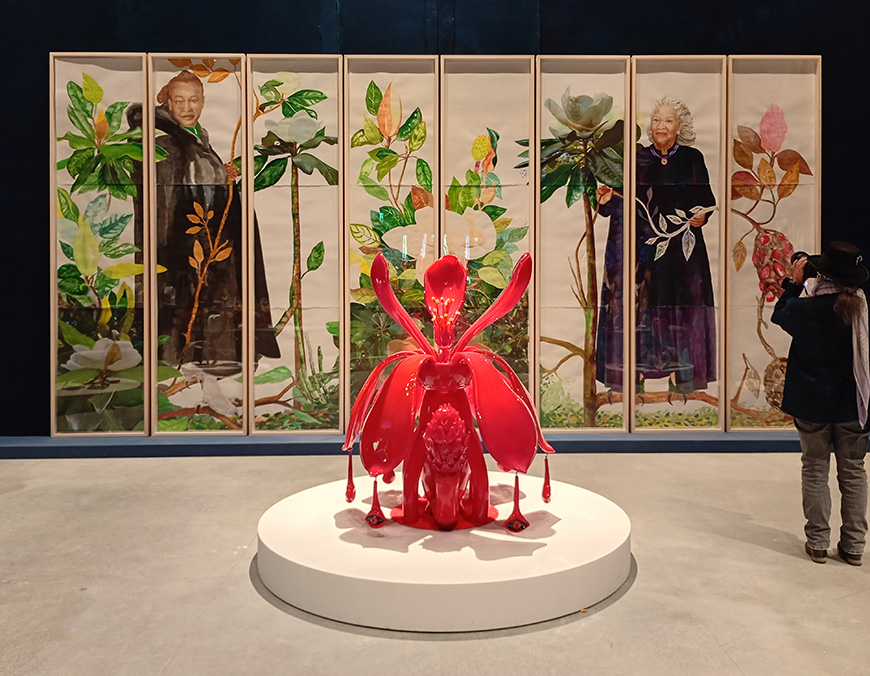
María Magdalena Campos-Pons, Anatomy of the Magnolia Tree for Koyo Kouoh and Toni Morrison; photo © Federica Lusiardi, Inexhibit 2026
Leonilda González – Novias Revolucionarias, 1968
With her remarkable series of woodcuts Novias Revolucionarias, Leonilda González (1923–2017) uses irony and biting sarcasm to expose and critique the conventions and conformisms of Uruguay at the time. Her gaze focuses particularly on the condition of women, while also addressing—more broadly—the socio‑political situation of her country.
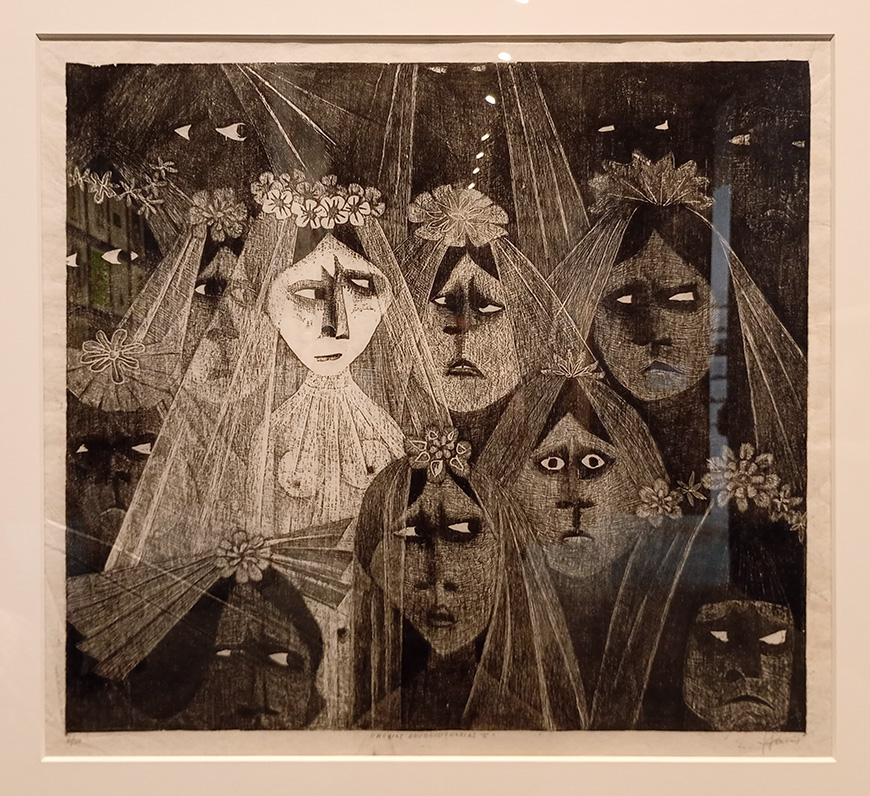
Leonilda González, a woodcut from the series Novias Revolucionarias; photo © Federica Lusiardi, Inexhibit 2026
Hala Schoukair – Untitled
The Lebanese artist Hala Schoukair draws on her lifelong passion for nature and forests to create her large-scale paintings, where organic forms repeat and overlap to generate images that are both profound and mysterious.
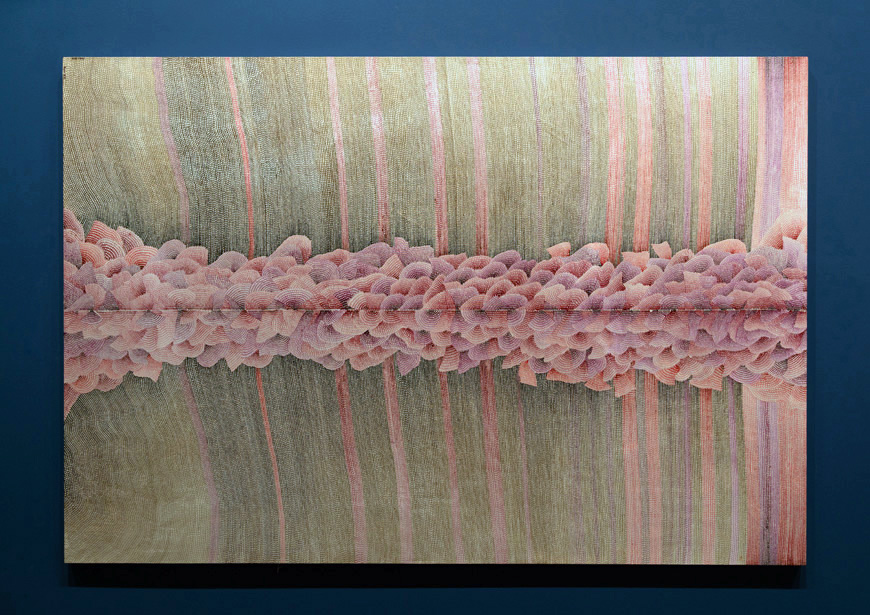
Hala Schoukair – Untitled; photo © Riccardo Bianchini, Inexhibit 2026
Alice Maher – The Sibyls, 2025
In The Sibyls, Irish artist Alice Maher pairs four large metal droplets with an equal number of drawings depicting female figures inspired by the sibyls of mythology. From these figures emerge vast masses of hair—hair in which they appear at times imprisoned, and at other times in the act of breaking free—creating a dynamic, tension‑filled relationship.
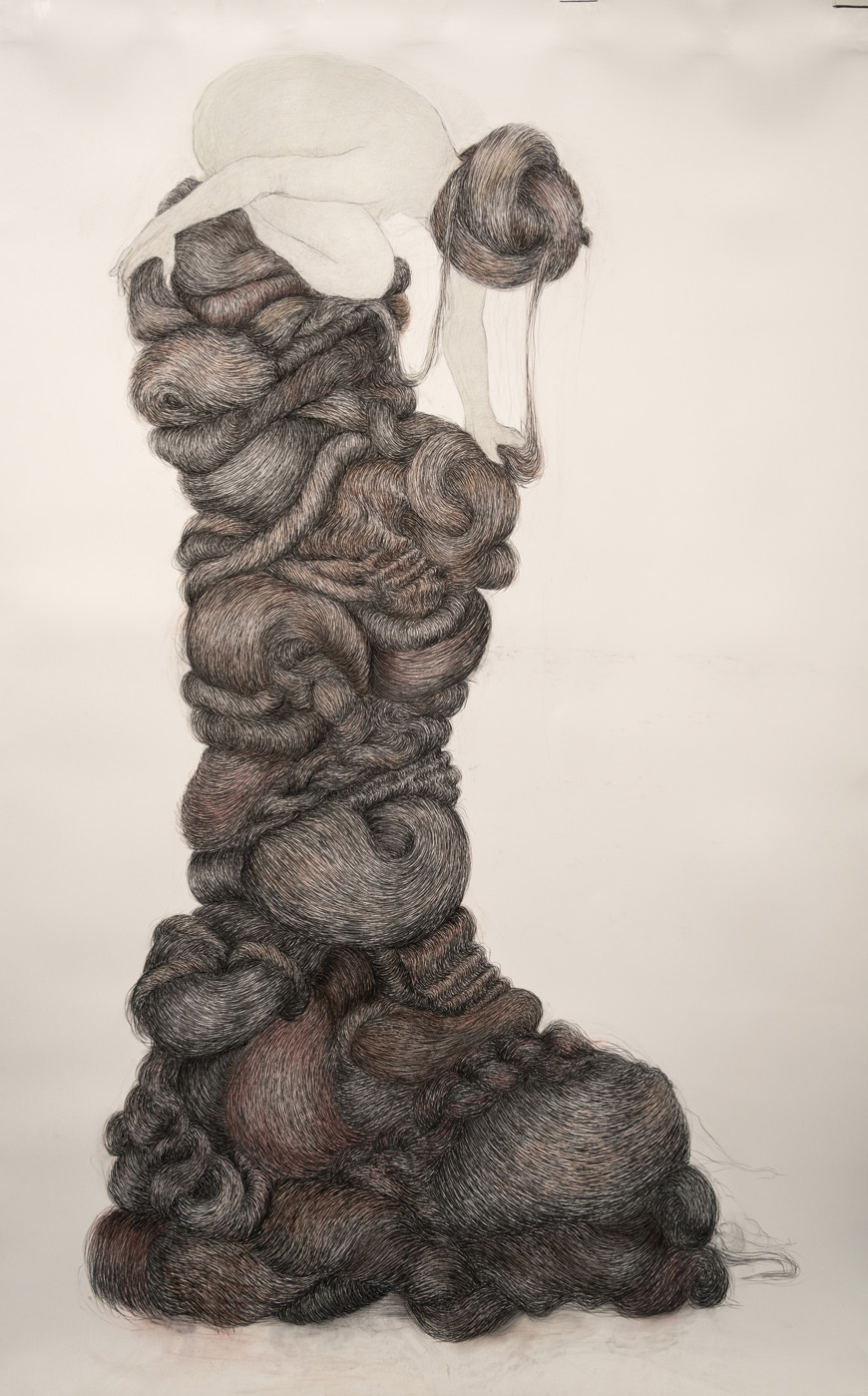
Alice Maher, The Sybils (detail); photo © Riccardo Bianchini, Inexhibit 2026
ARSENALE
Khaled Sabsabi – Khalil, 2026
The circular space of Khalil—a word that in Arabic means “brotherly friend”—is conceived as a place of reflection and contemplation, positioned at the entrance to the Corderie. The installation combines a video projection, acrylic painting on canvas, and the fragrance of black oud, an aromatic resin.
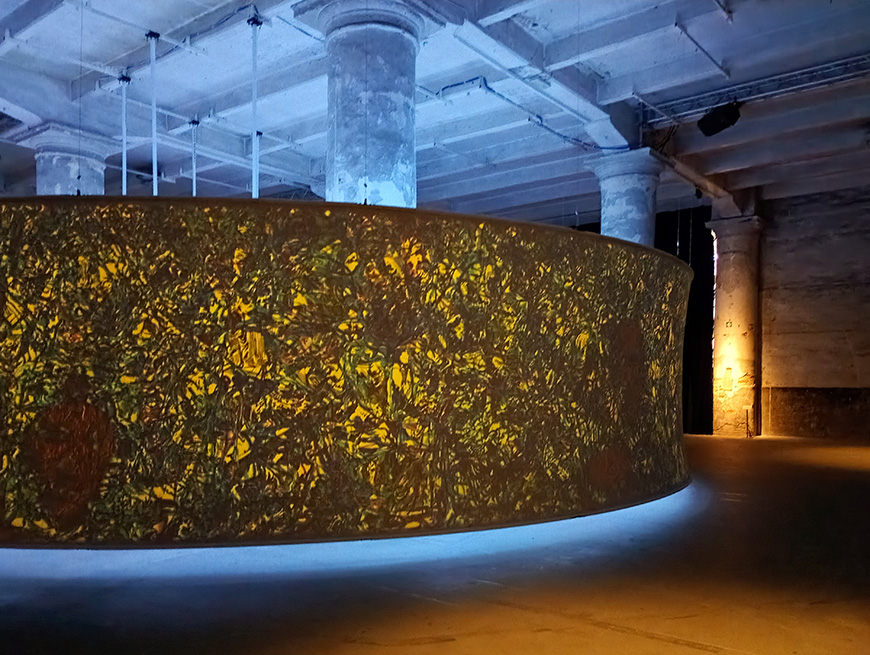
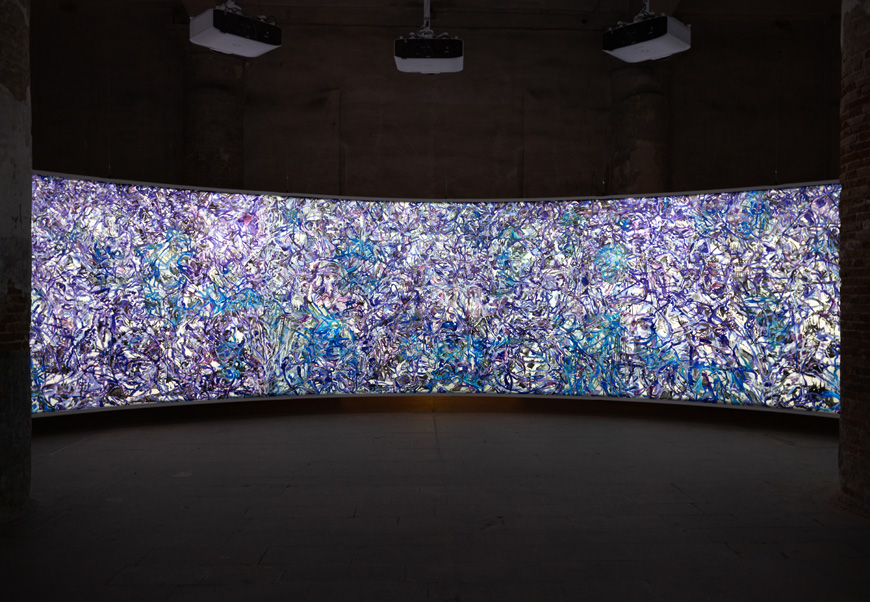
Khaled Sabsabi, Khalil, photos © Federica Lusiardi and © Riccardo Bianchini, Inexhibit 2026
Theo Eshetu – Garden of the Broken Hearted, 2026
The olive tree placed on a rotating base symbolizes uprooting and resilience, evoking a sense of alienation from its place of origin and from its natural function. Yet the plant clings to life, resisting the absence of natural light and its need for water. Images recorded before its relocation to Venice are projected onto the tree.
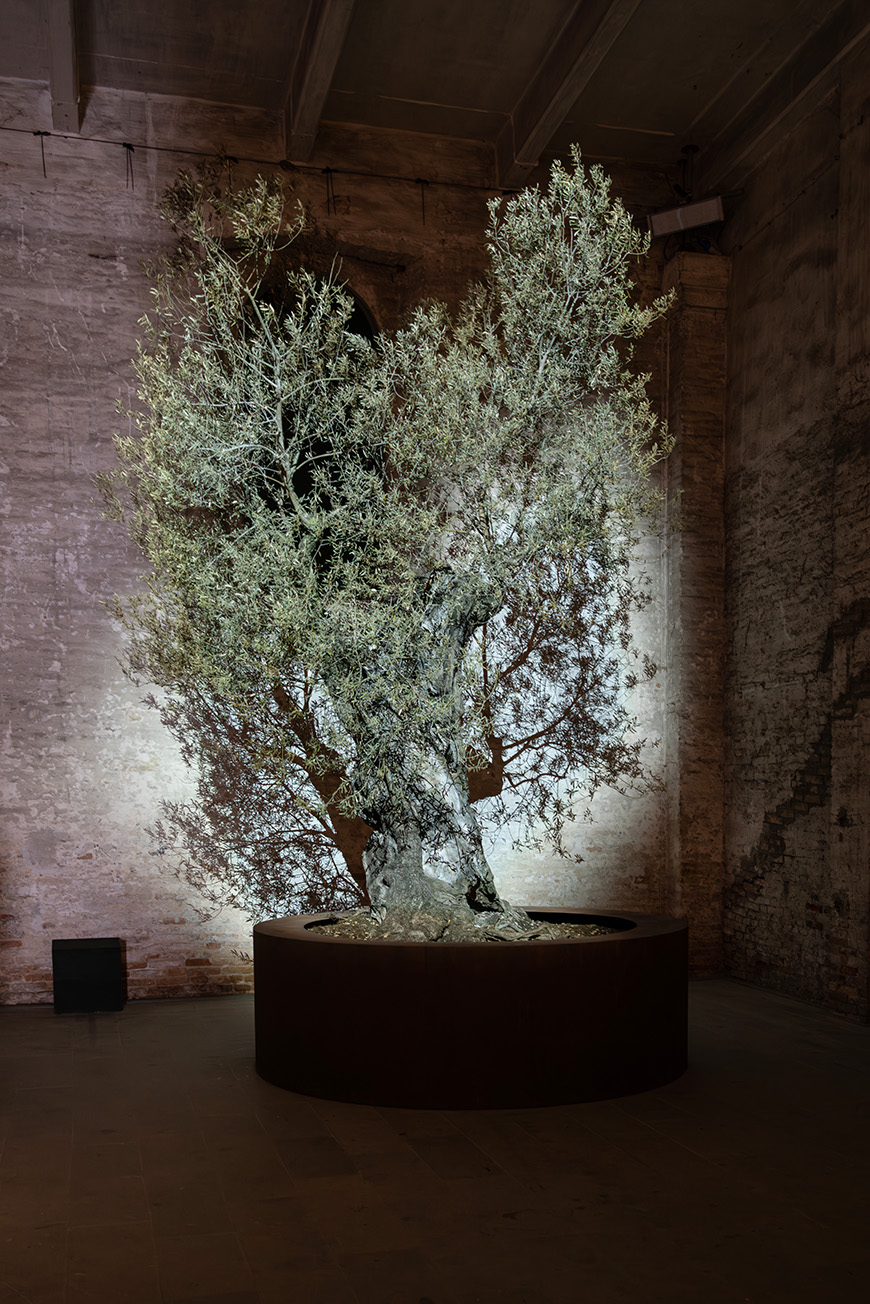
Theo Eshetu – Garden of the Broken Hearted, photo © Riccardo Bianchini, Inexhibit 2026
Guadalupe Maravilla – ICE Age Disease Thrower #2, #3, #4, 2025
Guadalupe Maravilla’s works are deeply connected to his personal history—his childhood journey from El Salvador to the United States, his experience with illness, and his ongoing activism. The “Disease Throwers” exhibited at this year’s Biennale are conceived both as sanctuaries and as musical instruments, and they are built from handmade objects and found materials. In the current political climate, faced with the sickness of xenophobia, the sculptures are offered to the public as healing tools that encourage introspection and a sense of community.
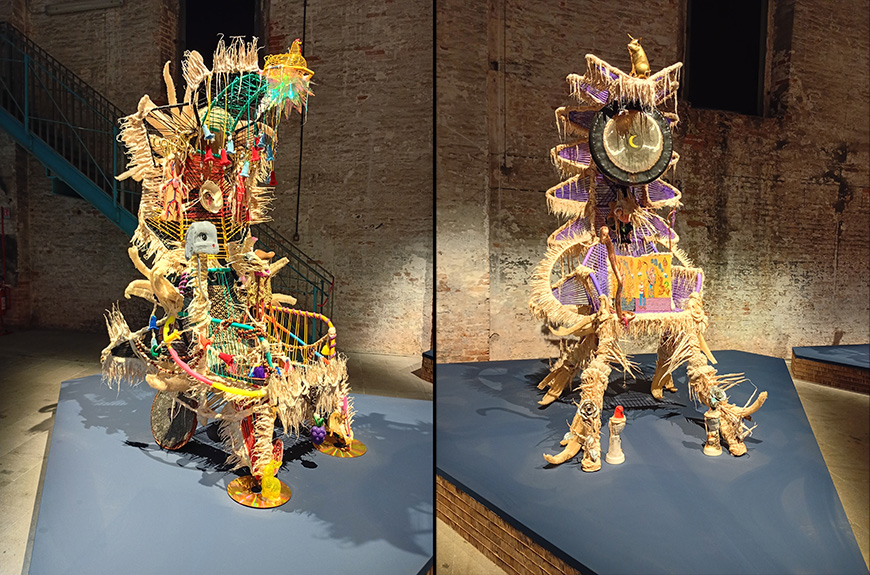
Guadalupe Maravilla, installation views; photos © Federica Lusiardi, Inexhibit 2026
Carrie Schneider – First Living Woman, 2026
The work consists of an enormous one‑kilometre‑long roll of industrial chromogenic paper onto which the artist has transferred selected film frames featuring women. With First Living Woman, and through the medium of cinema, Schneider restores weight and centrality to materiality and to history at large, countering the sense of loss generated by the distracted, frictionless act of scrolling on mobile phones.
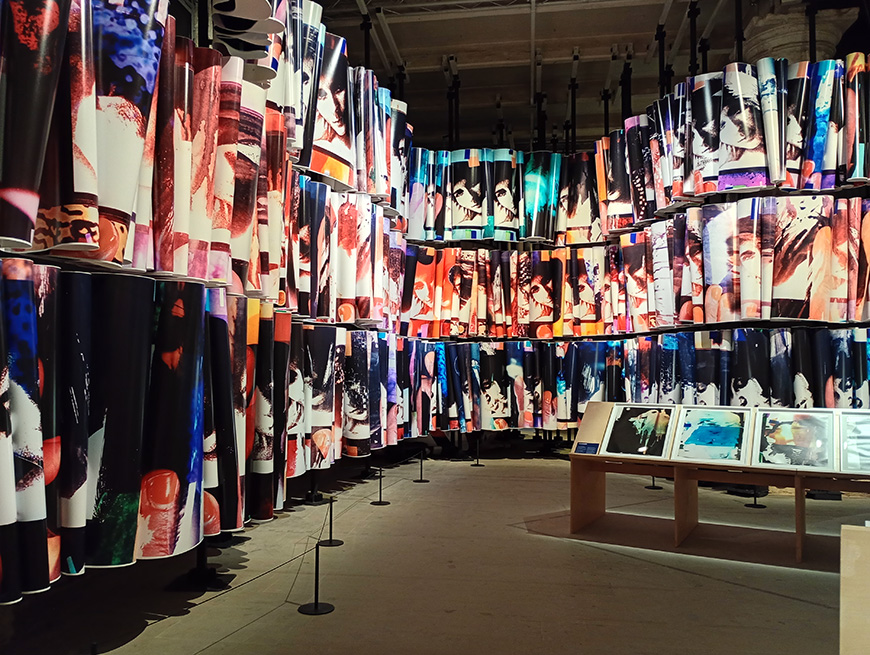
Carrie Schneider, First Living Woman; photo © Federica Lusiardi, Inexhibit 2026
Alfredo Jaar – The End of the World (2023, 2024)
Placed inside a display case, the small cube—measuring just 4 cm per side—is composed of cobalt, nickel, lithium, manganese, copper, rare earth elements, and other precious minerals that are crucial to the development of both civilian and military technologies. Each layer of the cube triggers geopolitical tensions and carries environmental and social consequences. It stands as a symbol of human rapacity, a reminder of our readiness to consume and exploit resources even beyond our own planet. *
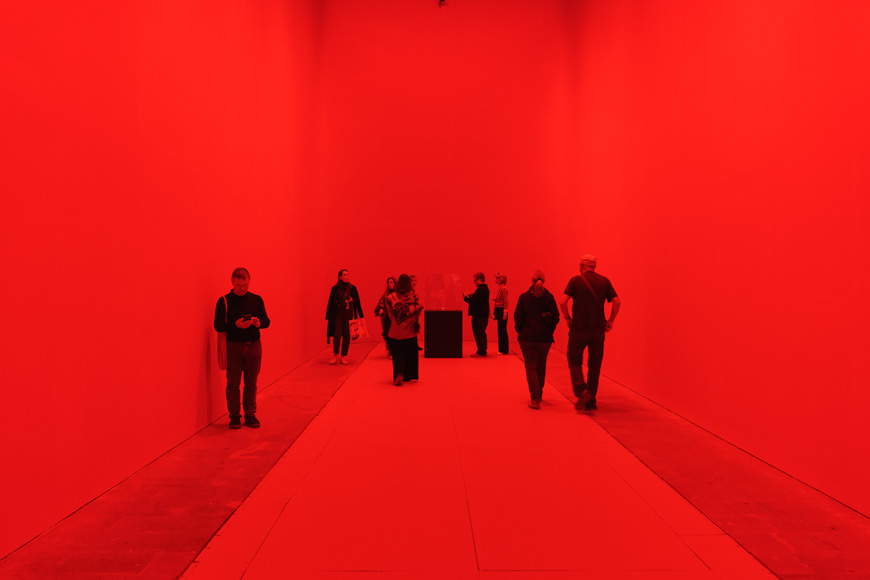
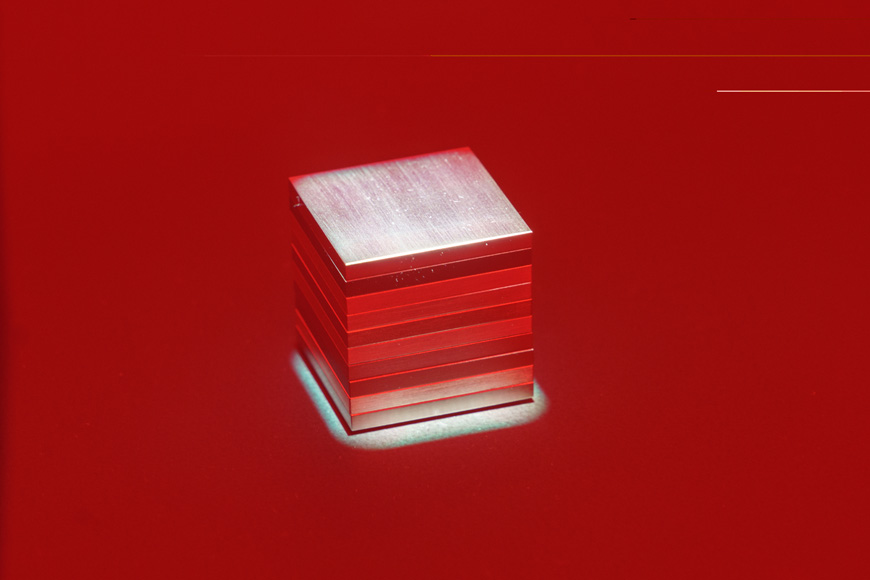
Alfredo Jaar, The End of the World, photos © Riccardo Bianchini, Inexhibit 2026
Kader Attia – Whisper of Traces, 2026
Whisper of Traces takes inspiration from the words of a shaman who claimed that computer viruses are spirits attempting to hinder human domination over the virtual world. Through a hybrid, magical landscape composed of natural elements, ritual sculptures, modern art, and ropes covered in mirrors, the artist asks whether it is technology that shapes space, or whether it is instead spirits that control technology. *
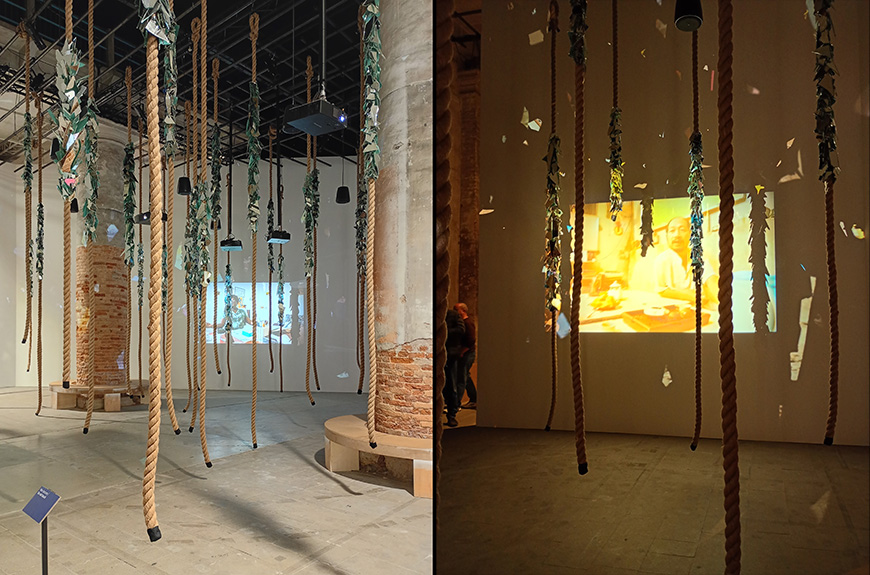
Kader Attia – Whisper of Traces; photo © Federica Lusiardi, Inexhibit 2026
Senzeni Marasela – Installation of several works, 2025
The large textile work suspended from the trusses of the Corderie is composed of red wool drapes hand‑stitched onto tjali, ceremonial blankets. The stitches trace the maps of the slopes of mines that have collapsed, and the titles refer to mining accidents that occurred in South Africa, indicating the location, date, and number of victims. Born near an abandoned gold mine outside Johannesburg, the artist confronts the emotional and political impact of extractive activity on the lives of African women, as well as the irreparable damage caused by forced migration and the labor systems of apartheid.
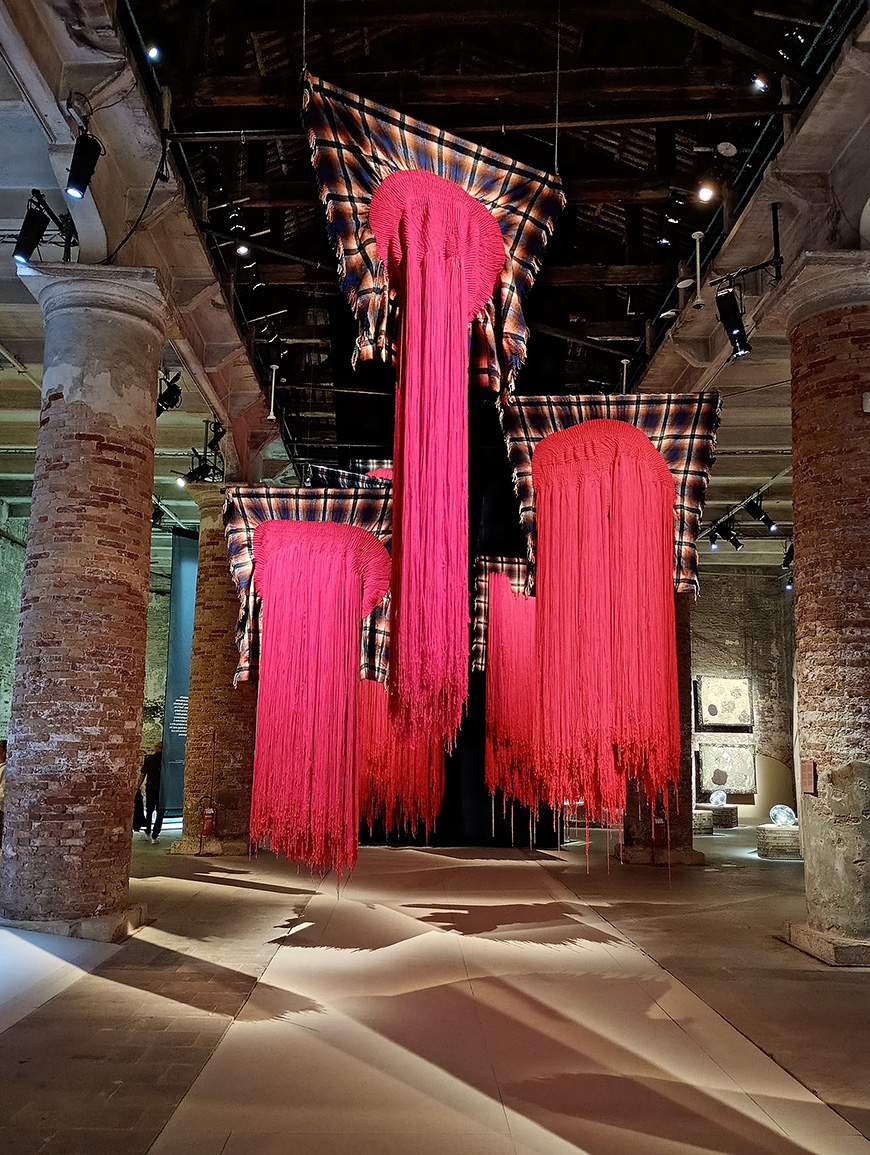
Senzeni Marasela – installation view; photo © Federica Lusiardi, Inexhibit 2026
Ayrson Heráclito – Juntòs, 2025
Juntòs is the title of the installation composed of drawings and stainless‑steel sculptures. The work refers to the symbols of the Orixás, which in Candomblé—a religion born from the convergence of the spiritual knowledge of different African peoples forcibly brought to Brazil—constitute the pantheon of deities. In Candomblé, each person is guided by at least two Orixás: the primary one, considered the mother or father, and a secondary deity that offers emotional support and fosters wisdom. The 222 drawings correspond to the possible combinations of juntós, formed by primary and secondary Orixás.
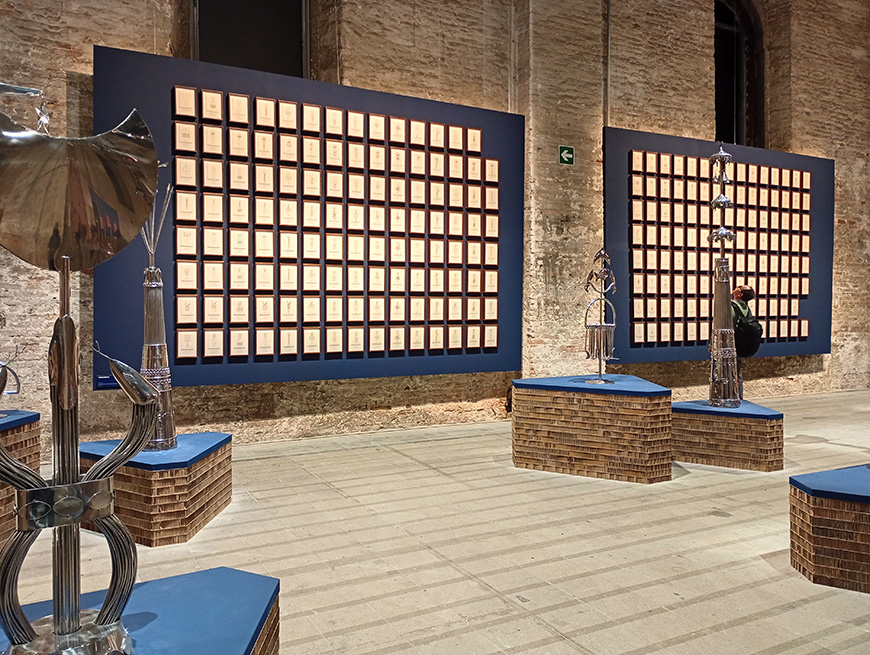
Ayrson Heráclito – Juntòs; photo © Federica Lusiardi, Inexhibit 2026
Nick Cave – Amalgam (Origin), 2024
At the 2026 Venice Art Biennale, the American artist Nick Cave presents several works. Among them, Amalgam (Origin) stands out. Part of the Amalgam series, it is a monumental bronze sculpture overlooking the Arsenale basin, depicting a large standing human figure that is hybridized—one might say colonized—by nature in the form of vegetal and animal elements. In Cave’s work, often tied to politics and in particular to the rights denied to people of color in the United States, the sculptures in the Amalgam series symbolize the strength of resistance against oppression, as well as inner growth and awareness.
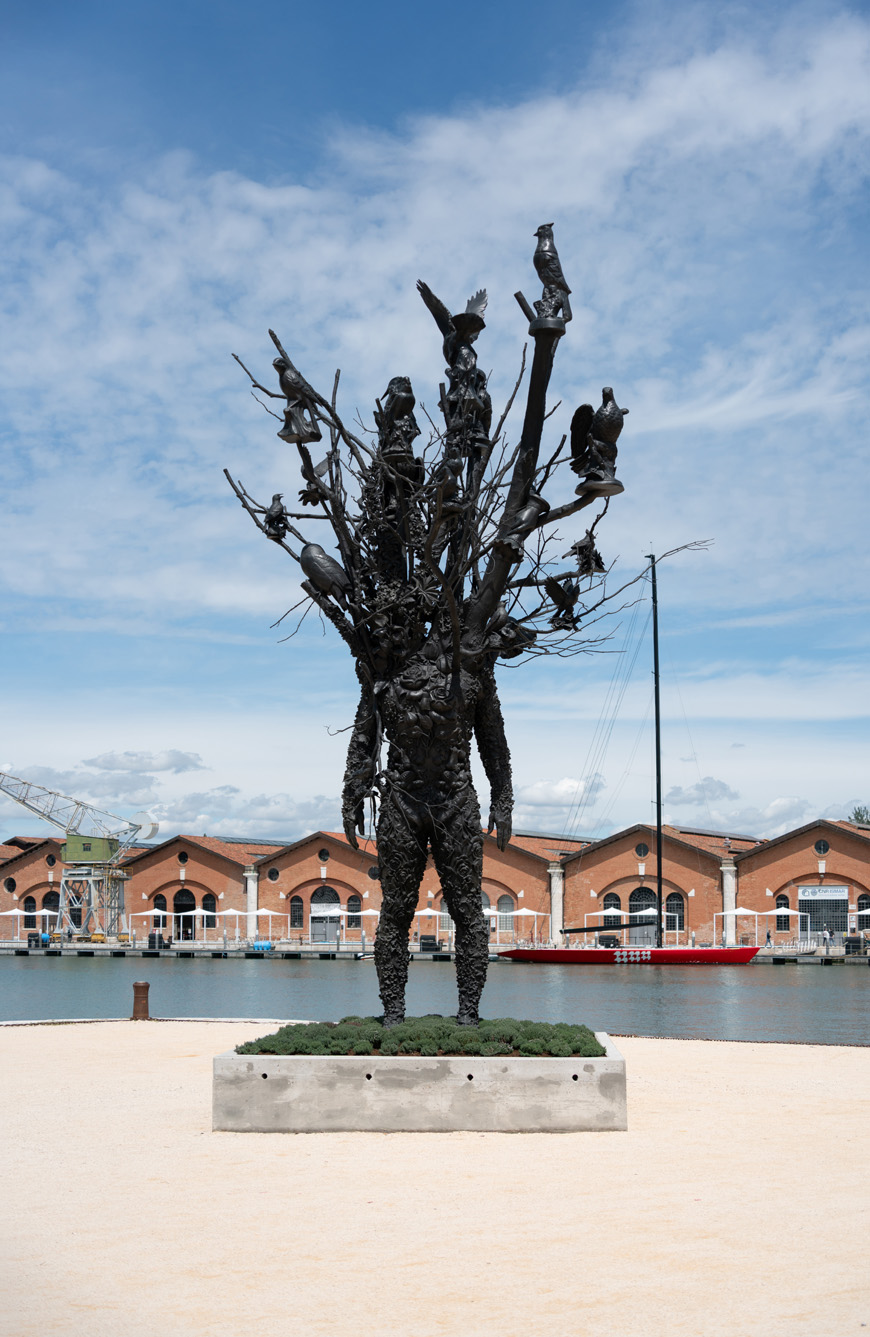
Nick Cave, Amalgam (Origin); photo © Riccardo Bianchini, Inexhibit 2026
Carsten Höller – Giant Triple Mushroom, 2025
Trained as an agronomist, Carsten Höller has long been fascinated by mushrooms—their forms, their elusive nature, and their traditional role within Indo‑European magical culture. For the 2026 Biennale, Höller installs in the Giardino delle Vergini a monumental sculpture that hybridizes various mushroom species with Amanita muscaria, the quintessential “magic” mushroom.
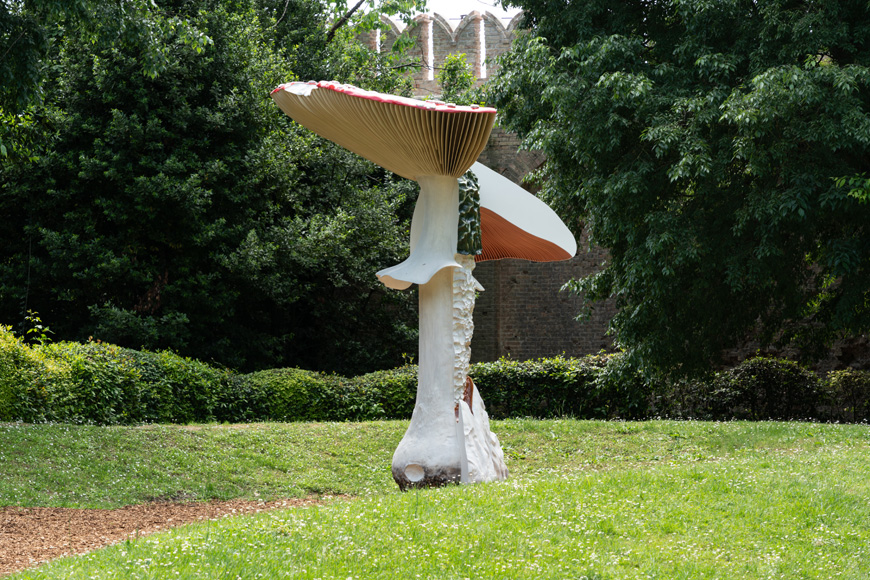
Carsten Höller, Giant Triple Mushrooms; photo © Riccardo Bianchini, Inexhibit 2026