
Guggenheim Museum Bilbao – Frank O. Gehry
Euskadi - País Vasco, Spain
Phone: +34 944 35 90 80
Website: https://www.guggenheim-bilbao.eus/en
How our readers rate this museum (you can vote)

 (9 votes, average: 4.56 out of 5)
 Loading...
The Guggenheim Museum Bilbao is a leading institution for modern and contemporary art and an internationally celebrated architectural landmark in Bilbao, the largest city in Spain’s Basque Country.
History
Part of the global Guggenheim network – which also includes museums in New York, Venice, and Abu Dhabi – the Bilbao branch opened to the public on October 18, 1997. Designed by Canadian‑born American architect Frank O. Gehry, the building is renowned for its sweeping, titanium‑clad forms. Since its inauguration, the museum has played a pivotal role in Bilbao’s transformation from a struggling industrial port into one of Spain’s most vibrant cultural and leisure destinations.
The project was conceived as a bold experiment: could a major cultural institution revitalize an entire city? The answer came through a partnership between the Basque government, which provided funding and the site, and the Solomon R. Guggenheim Foundation, which contributed management expertise and a core collection of artworks on loan. A third essential element was Gehry’s iconic design, intended to serve as the museum’s unmistakable hallmark. The success of this initiative was so striking that the term Bilbao Effect was coined to describe the phenomenon of urban renewal driven by a landmark cultural project.
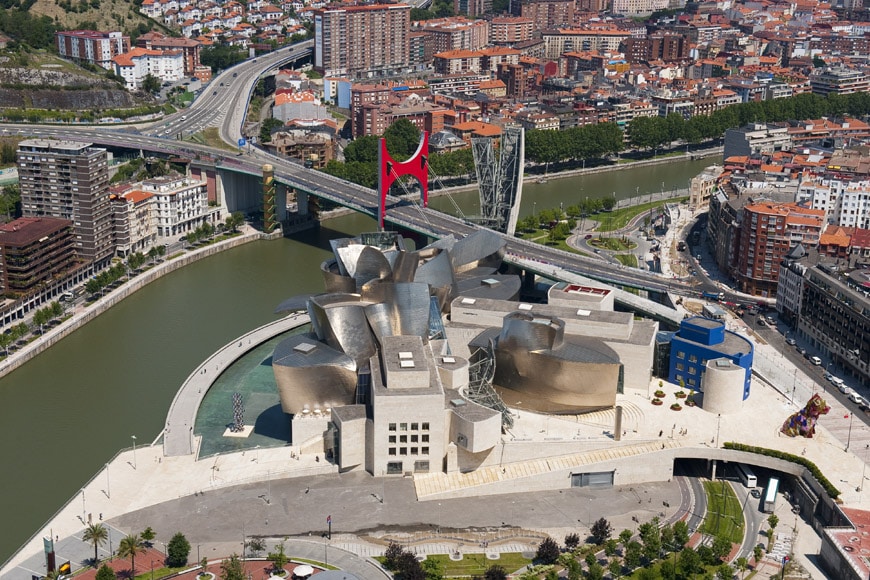
Aerial view of the Guggenheim Museum Bilbao from the Iberdrola Tower, situated on a former industrial site along the Nervión River. Photo by Erika Ede, courtesy of the Guggenheim Museum Bilbao.
Frank Gehry’s Building
The museum occupies a riverside site in Bilbao’s former port district, along the Nervión River. Often considered Gehry’s most celebrated work, the Guggenheim Bilbao blends the fragmented geometries of Deconstructivism with fluid, organic forms.
At its heart lies a vast atrium – a luminous, cavernous space flooded with daylight from expansive glazed openings and skylights. The museum’s twenty galleries, spread across three floors, are linked by bridges, corridors, elevators, and stairways.
The building’s exterior, atrium, and several ground‑floor galleries showcase complex curves and dramatic use of natural light, while many exhibition spaces adopt a more restrained “white cube” format, free of windows or external views.
The contrast between the shimmering titanium cladding outside and the more modest interior finishes—such as cardboard partitions—creates a striking duality. At 24,000 square meters (258,000 square feet), the building is visually spectacular, sometimes resembling a theatrical stage set as much as a piece of architecture.
Because of its double‑curved titanium skin and intricate structural frame, traditional design methods of the early 1990s proved insufficient. The Guggenheim Bilbao thus became one of the first major architectural projects to rely extensively on computer‑aided design, using CATIA software developed by Dassault Systèmes for the aerospace industry.
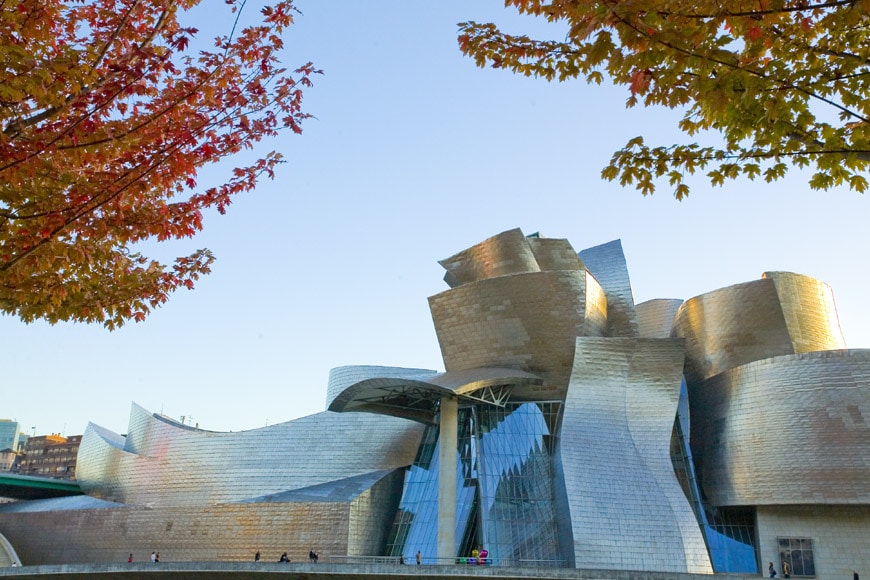
Guggenheim Bilbao, north facade; photo: Erika Ede, © FMGB Guggenheim Bilbao Museum
The Collection
The museum’s holdings focus on leading artists of the 20th and 21st centuries.
In addition to works on long‑term loan from the Guggenheim Foundation, the Bilbao collection includes acquisitions and commissions by Jean‑Michel Basquiat, Anselm Kiefer, Willem de Kooning, Robert Motherwell, Sigmar Polke, Gerhard Richter, James Rosenquist, Clyfford Still, Cy Twombly, Andy Warhol, Joseph Beuys, Robert Rauschenberg, Mark Rothko, Francesco Clemente, and Sol LeWitt.
Special emphasis is placed on Basque and Spanish artists such as Eduardo Chillida, Juan Muñoz, Jorge Oteiza, Antonio Saura, and Antoni Tàpies.
Since its opening, the museum has also commissioned monumental site‑specific installations, including Richard Serra’s celebrated The Matter of Time, alongside works by Jeff Koons, Fujiko Nakaya, Anish Kapoor, Louise Bourgeois, Daniel Buren, and Yves Klein.
Programs and Facilities
The Guggenheim Bilbao hosts major temporary exhibitions, educational programs, workshops for adults and children, lectures, concerts, and a monthly late‑night event, Art After Dark, which combines music and art.
The building also houses a library, the ZeroEspazio interactive learning center, a bookshop, a café, and two restaurants. The museum is fully accessible, with wheelchairs available free of charge at reception.
Images
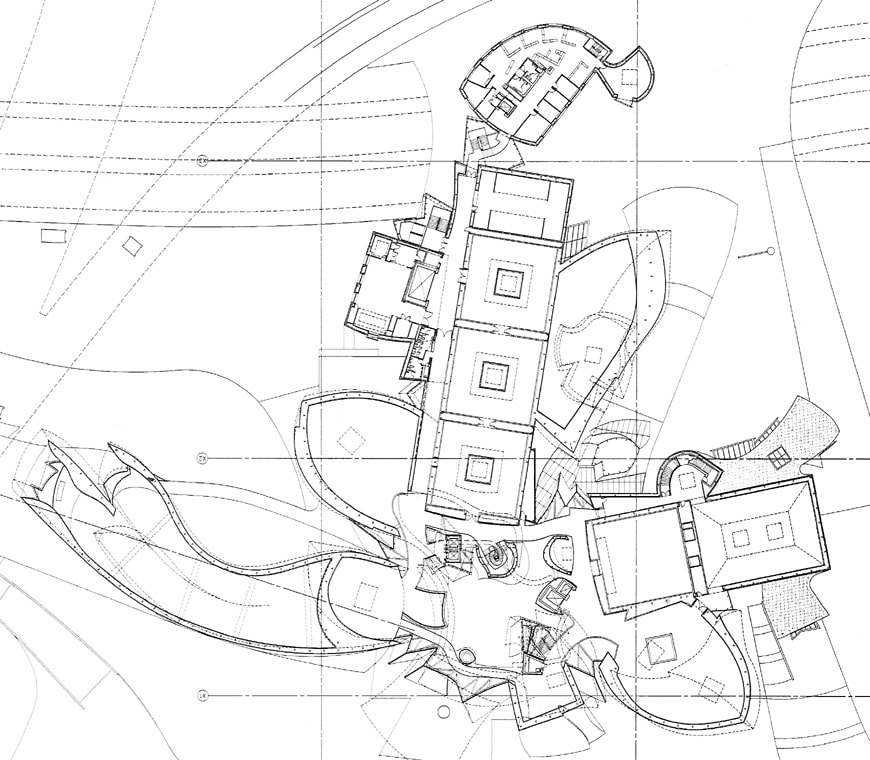
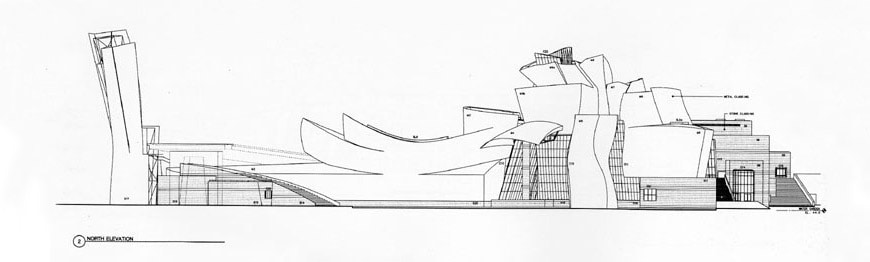
Guggenheim Bilbao, first-floor plan, and north elevation drawings by Gehry Partners LLP
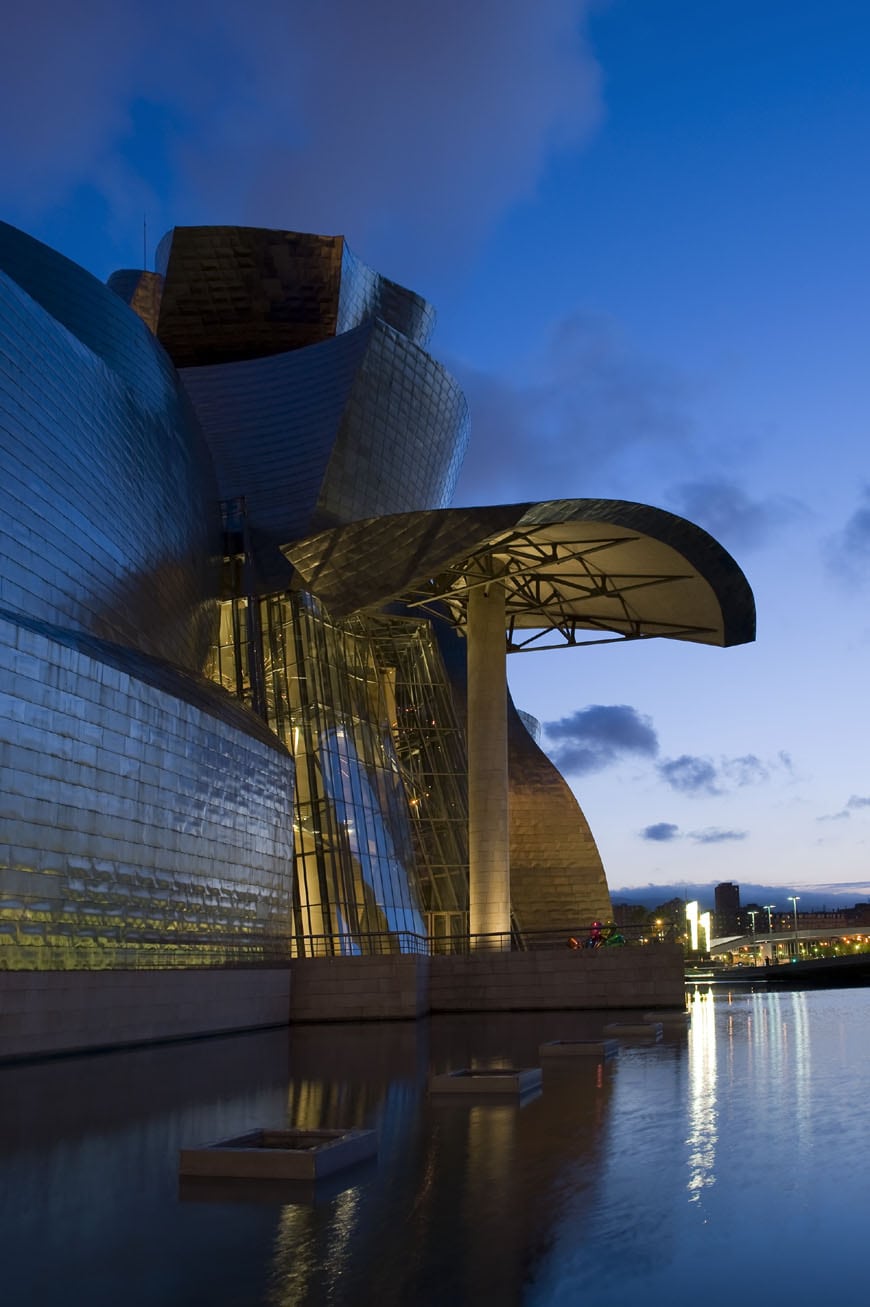
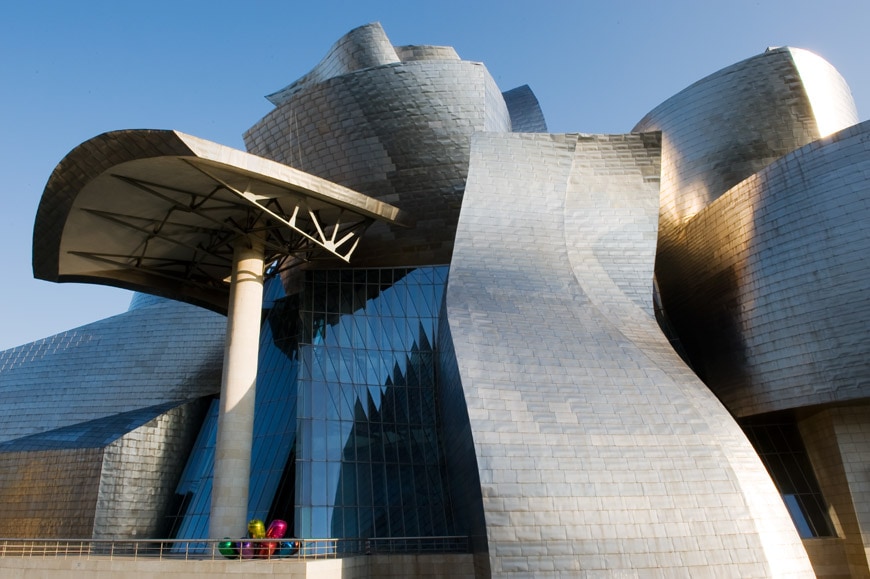
Views of the titanium-clad envelope of the building; photos: Erika Ede, and Johansen Krause, © FMGB Guggenheim Bilbao Museum
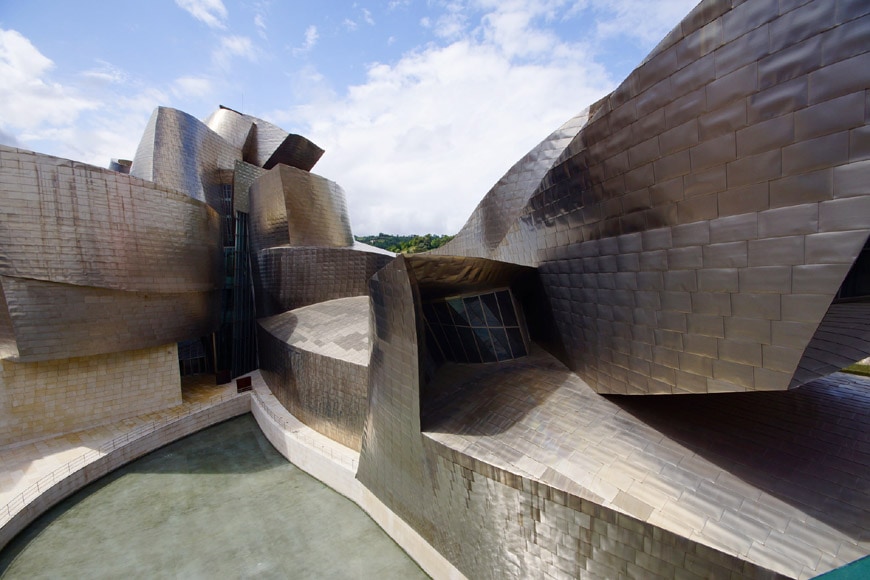
Photo: Olivier Dubois via Flickr CC BY-NC-ND 2.0
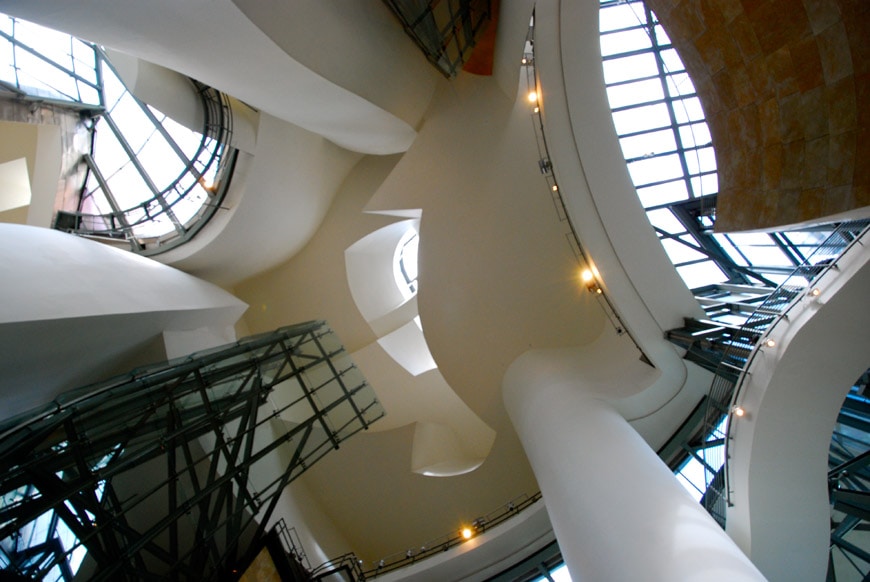
The atrium of the Guggenheim Bilbao; photo: Aris Gionis via Flickr CC BY-NC 2.0
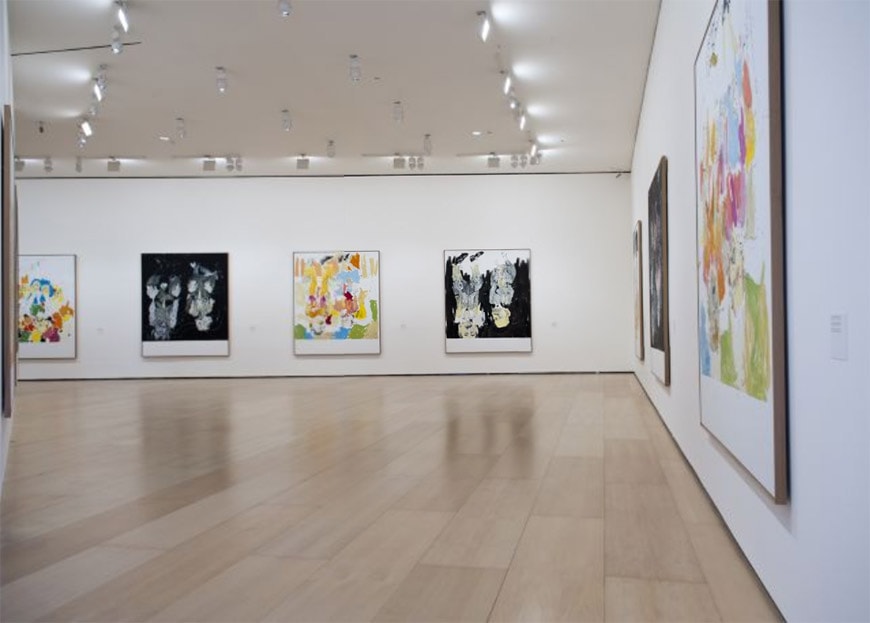

View of two of the museum’s “white box” galleries; photo courtesy of Guggenheim Bilbao
Cover image: photo by David M. Heald, © SRGF, New York, courtesy of the Solomon R. Guggenheim Foundation
copyright Inexhibit 2026 - ISSN: 2283-5474
