

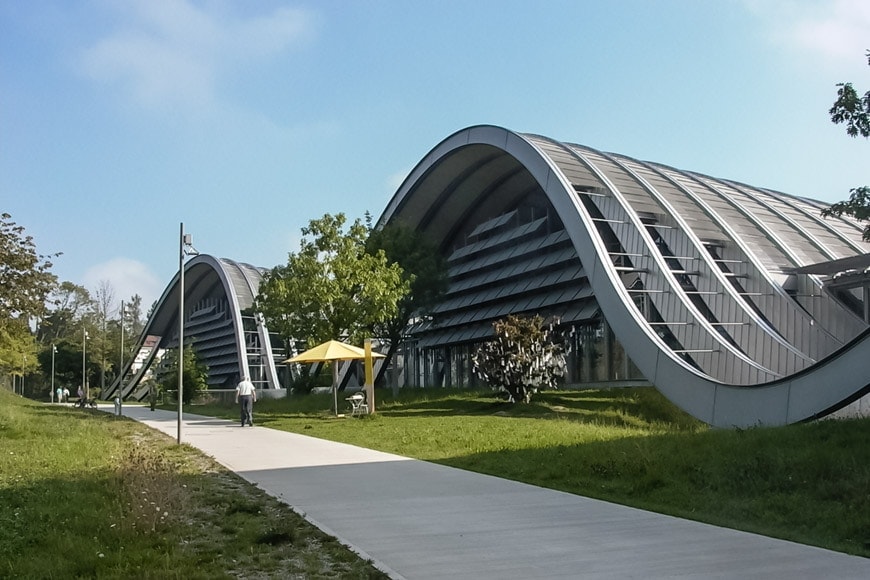
Exterior view of the Zentrum Paul Klee in Bern; photo © Riccardo Bianchini/Inexhibit.
The Zentrum Paul Klee is a museum of modern art and an exhibition center in Bern, primarily, yet not exclusively, dedicated to the Swiss artist from whom it takes its name.
The museum’s architecture
Designed by renowned Italian architect Renzo Piano, the museum’s building is a striking example of architectural harmony with nature. Inspired by the rolling hills surrounding Bern, its undulating metal roof is planted with grass and crops, blending seamlessly into the landscape. This design reflects Klee’s vision of unity between art and life, echoing themes found in his 1929 painting Monument im Fruchtland.
The museum’s structure is supported by curved metal ribs that form its iconic wave-like silhouette. Visitors are encouraged to explore the grounds, where the integration of architecture and vegetation is not only visual but functional—organic crops are cultivated on the roof by the Swiss College of Agriculture and a local farmer.
What to see inside
The Zentrum Paul Klee holds a permanent collection of over 4,000 works by the artist. These are presented in rotating thematic exhibitions that often include pieces by other influential artists such as Wassily Kandinsky, Sigmar Polke, Alexander Calder, and Henry Moore. This curatorial approach offers fresh perspectives on Klee’s legacy and artistic context.
Additional activities and services
The Zentrum Paul Klee includes temporary exhibition rooms, a large auditorium, a library, a cafeteria, a museum shop, rooms for special events and meetings, and the Creaviva space, an art workshop especially suited for children. The museum is fully accessible to visitors with physical impairments.

The Zentrum and its landscape, photo © Riccardo Bianchini/Inexhibit
The Zentrum Paul Klee in Bern transcends the conventional role of a museum dedicated solely to the Swiss artist whose name it bears. In addition to exhibiting the oeuvre of Paul Klee, the institution functions as a multidisciplinary cultural center, offering a diverse array of activities including temporary exhibitions, musical performances, academic seminars, educational programs, and interactive workshops for both adults and children, facilitated through its Creaviva learning initiative.
Architectural Vision and Integration with Nature
The museum’s architectural design, conceived by the Renzo Piano Building Workshop, embodies the concept of a “landscape sculpture.” This vision draws inspiration from the surrounding topography and reflects the philosophical underpinnings of Klee’s work, particularly his aspiration to harmonize art with everyday life. A notable example is his 1929 painting Monument im Fruchtland (Monument in the Fertile Country), which features stylized representations of cultivated fields.
Visitors are encouraged to engage with the building’s exterior, where the interplay between architecture and landscape is both visual and functional. The museum’s roof, covered with soil, is actively cultivated by the Swiss College of Agriculture in collaboration with a local farmer, yielding a substantial quantity of organic produce. The structure’s defining feature—a series of curved metal ribs—supports the undulating roofline that has become emblematic of the building

Zentrum Paul Klee, a conceptual sketch by Renzo Piano
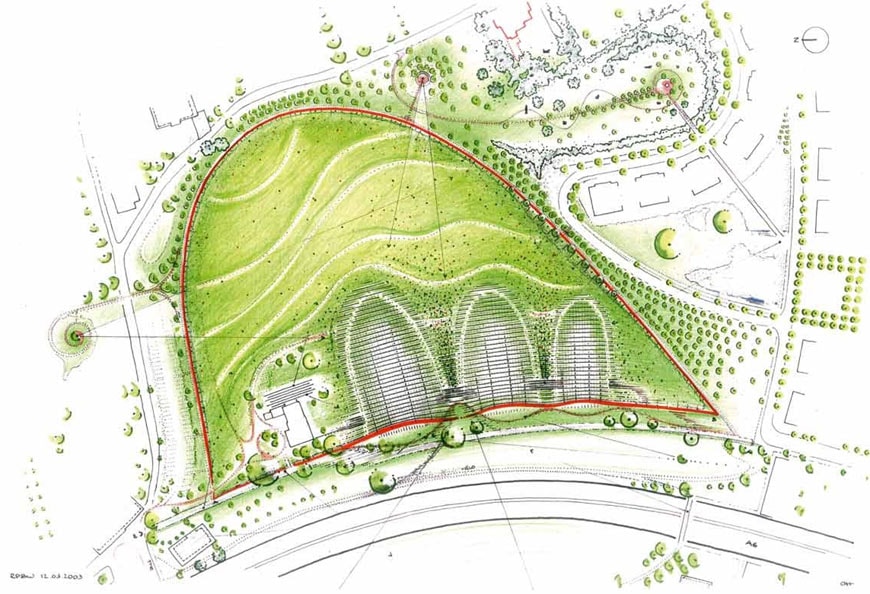
Zentrum Paul Klee, site plan; image © RBBW
Functional Layout and Visitor Amenities
The museum’s front section is dedicated to public engagement and includes creative studios, educational spaces, the Kindermuseum Creaviva, a library, a retail shop, and a café. The rear portion houses the exhibition galleries, an auditorium, and various operational facilities. Additionally, a separate restaurant is located in a nearby 19th-century villa, enhancing the center’s hospitality offerings.

Longitudinal section, © RPBW
Curatorial Approach and Exhibition Strategy
Works from the museum’s permanent collection are presented through rotating thematic exhibitions. These often incorporate loans from other institutions, thereby offering visitors continually refreshed perspectives on Klee’s artistic legacy and fostering a dynamic curatorial environment.
A Space for Reflection and Intellectual Enrichment
The Zentrum Paul Klee stands as a serene and intellectually stimulating venue. It not only deepens public appreciation for the visual arts but also encourages a contemplative and nuanced engagement with contemporary cultural discourse.

Photo © Riccardo Bianchini/Inexhibit
Zentrum Paul Klee, Monument im Fruchtland 3, Bern, Switzerland
https://www.zpk.org/en/
Open daily except Mondays, and December 24/25